Universal 35mm Cine Camera
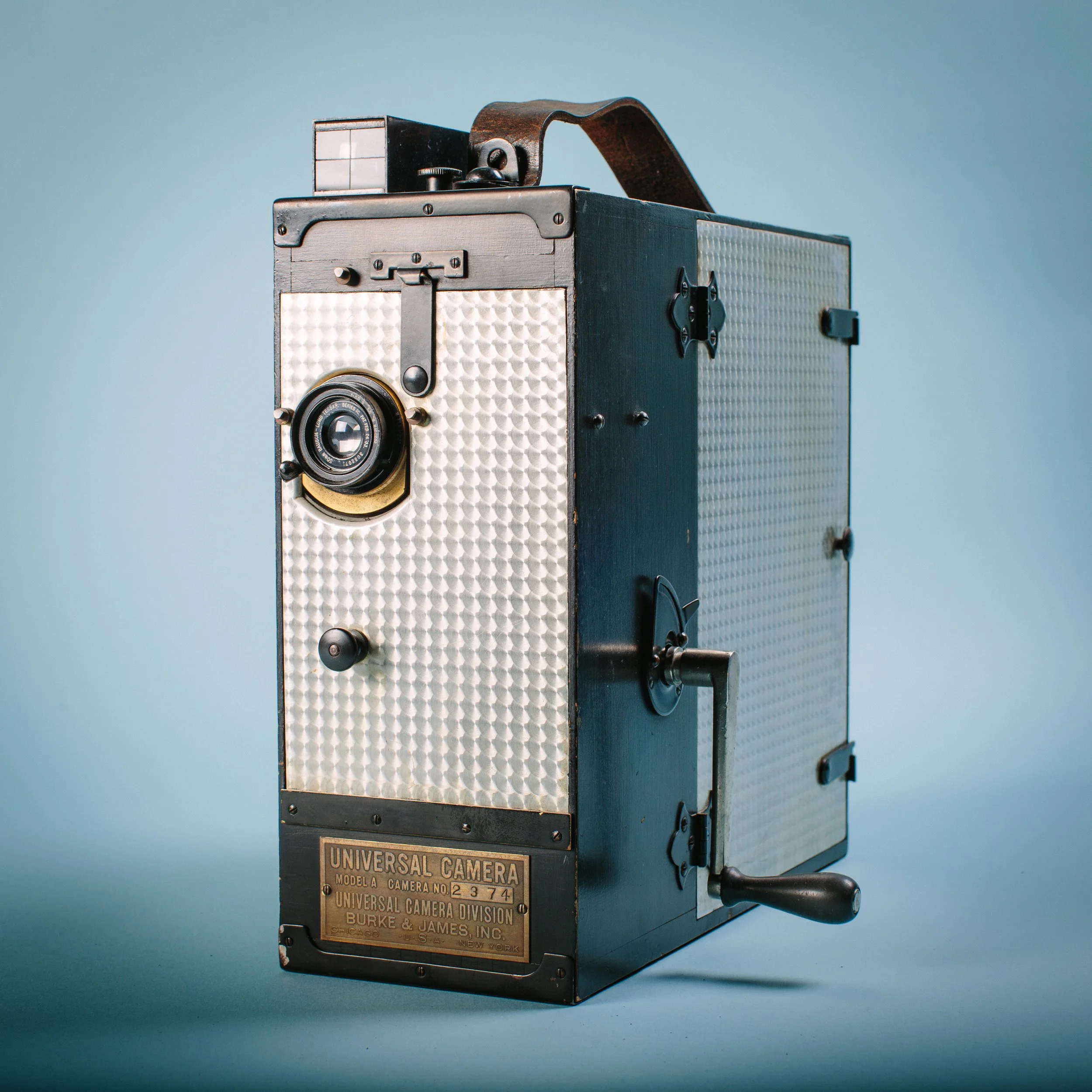
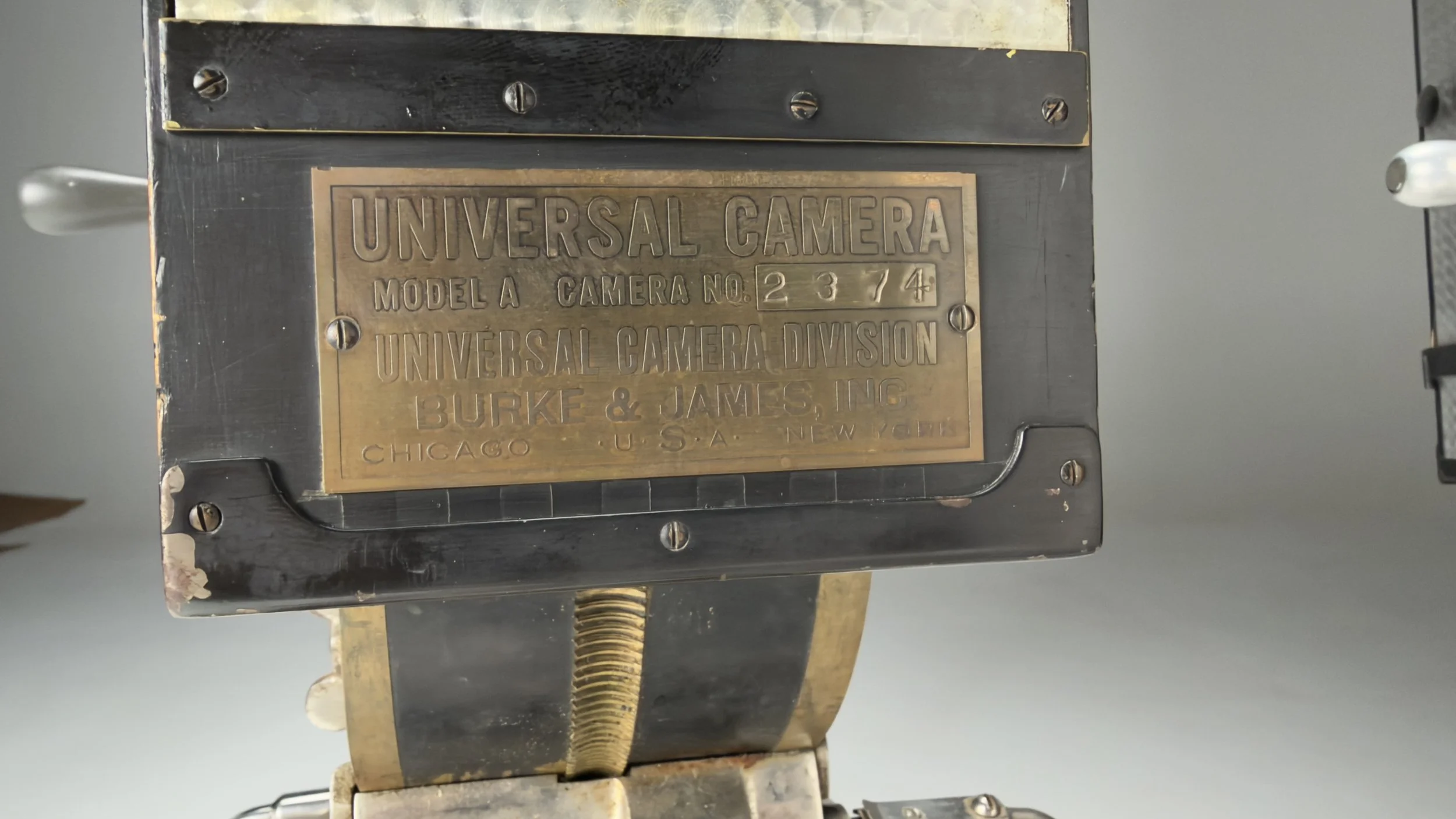
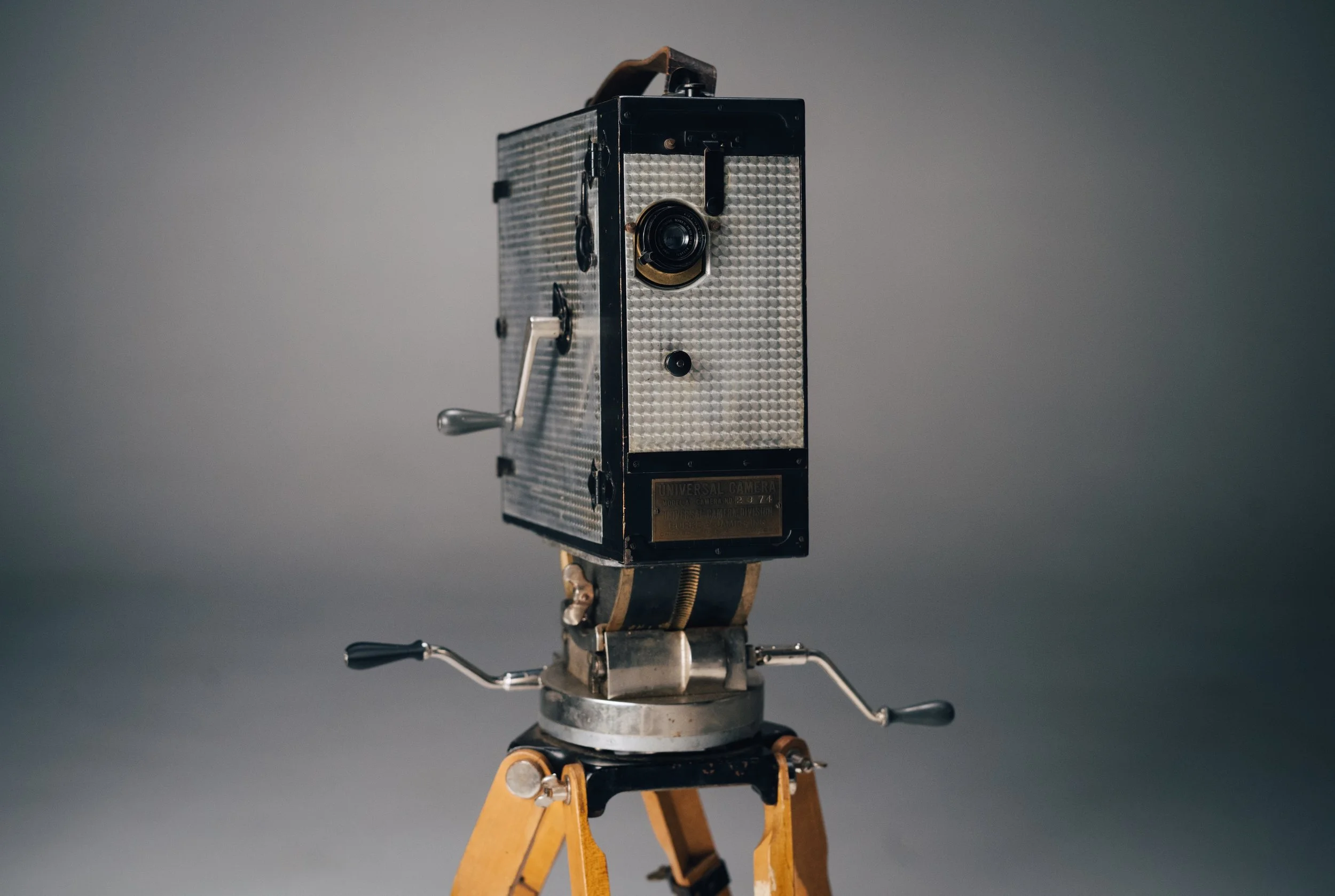
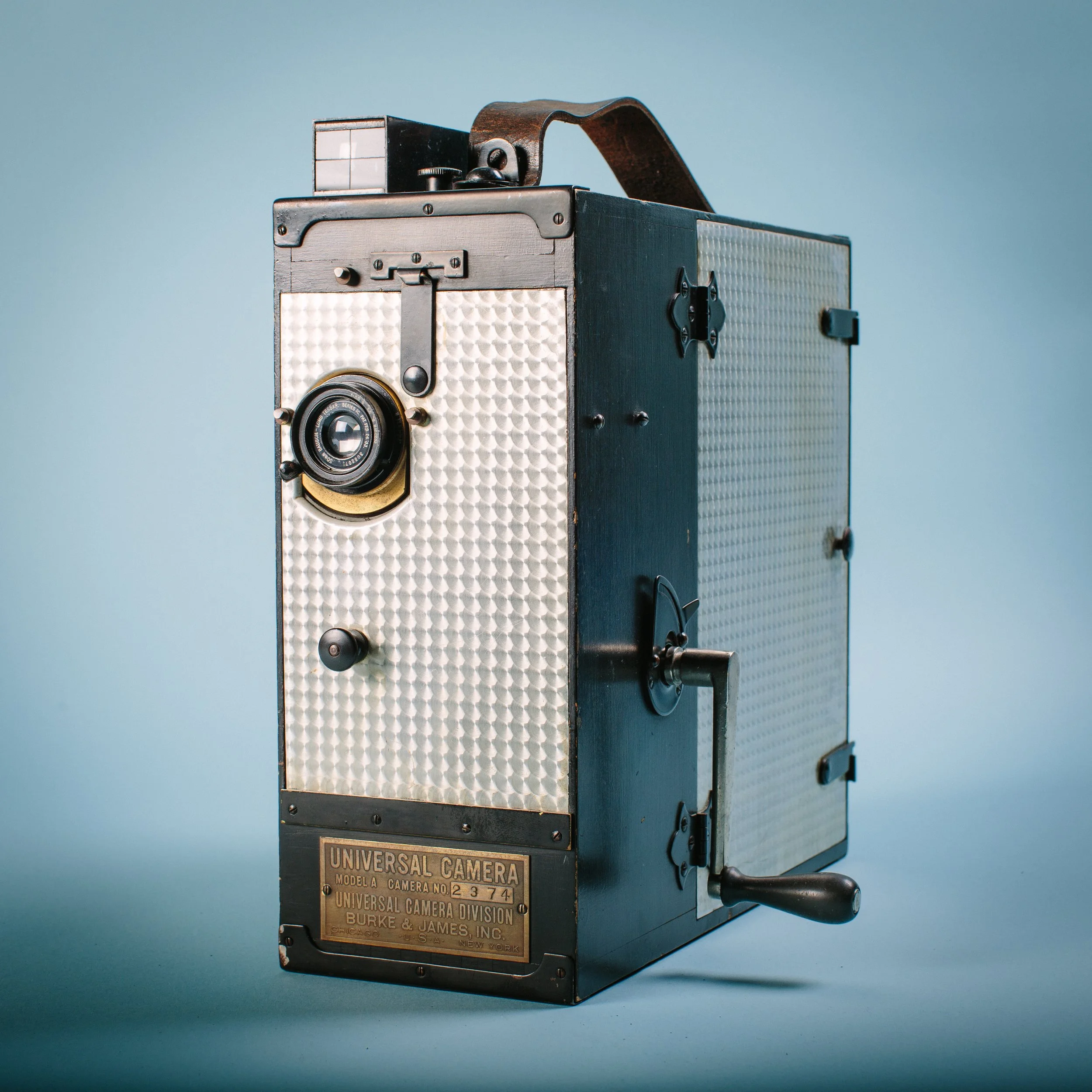
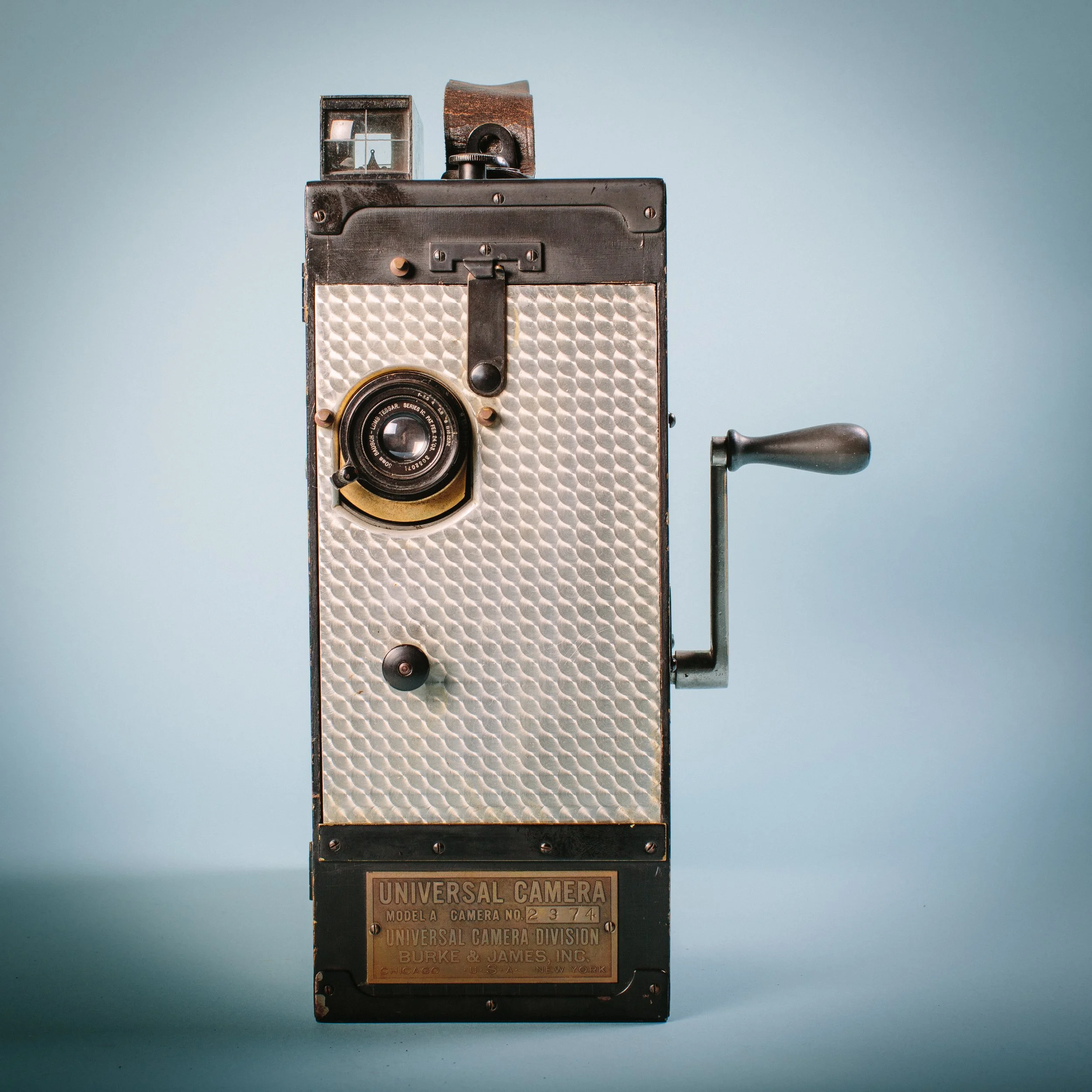
Universal No. 2374
On the ninth of November, 1919, a letter left Sydney, Australia, addressed to a camera company on Ontario Street, Chicago. Its author was Martin Johnson — the Kansas-born adventurer who, with his wife Osa, had just spent six months filming among the head hunters of Malekula in the New Hebrides. He had carried two cameras into the jungle and brought back twenty-five thousand feet of exposed negative. "Without a doubt they are the finest films I have ever made," he wrote. "In fact there is not a foot of poor film among the twenty-five thousand feet."
The cameras were Universals.
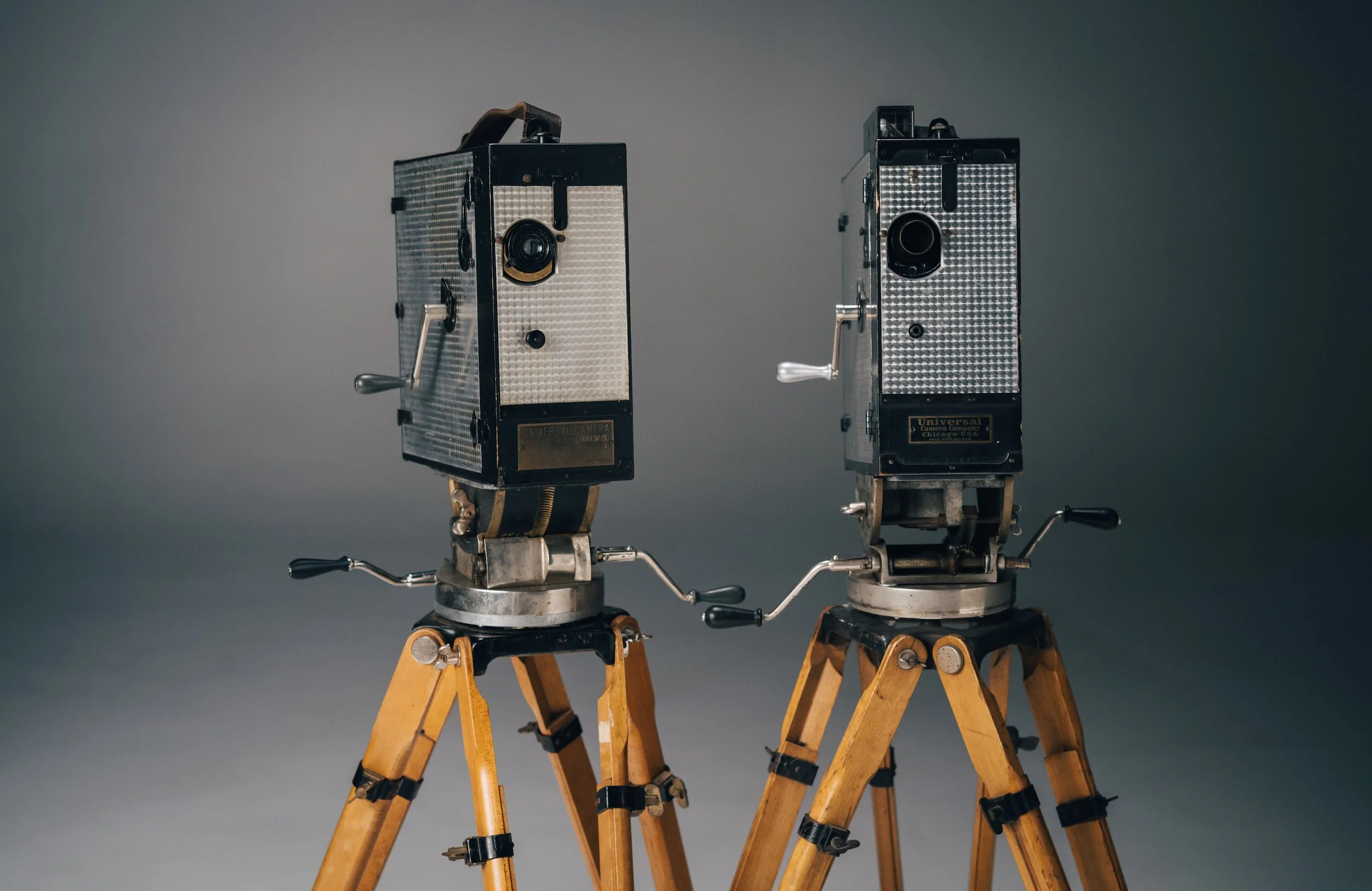
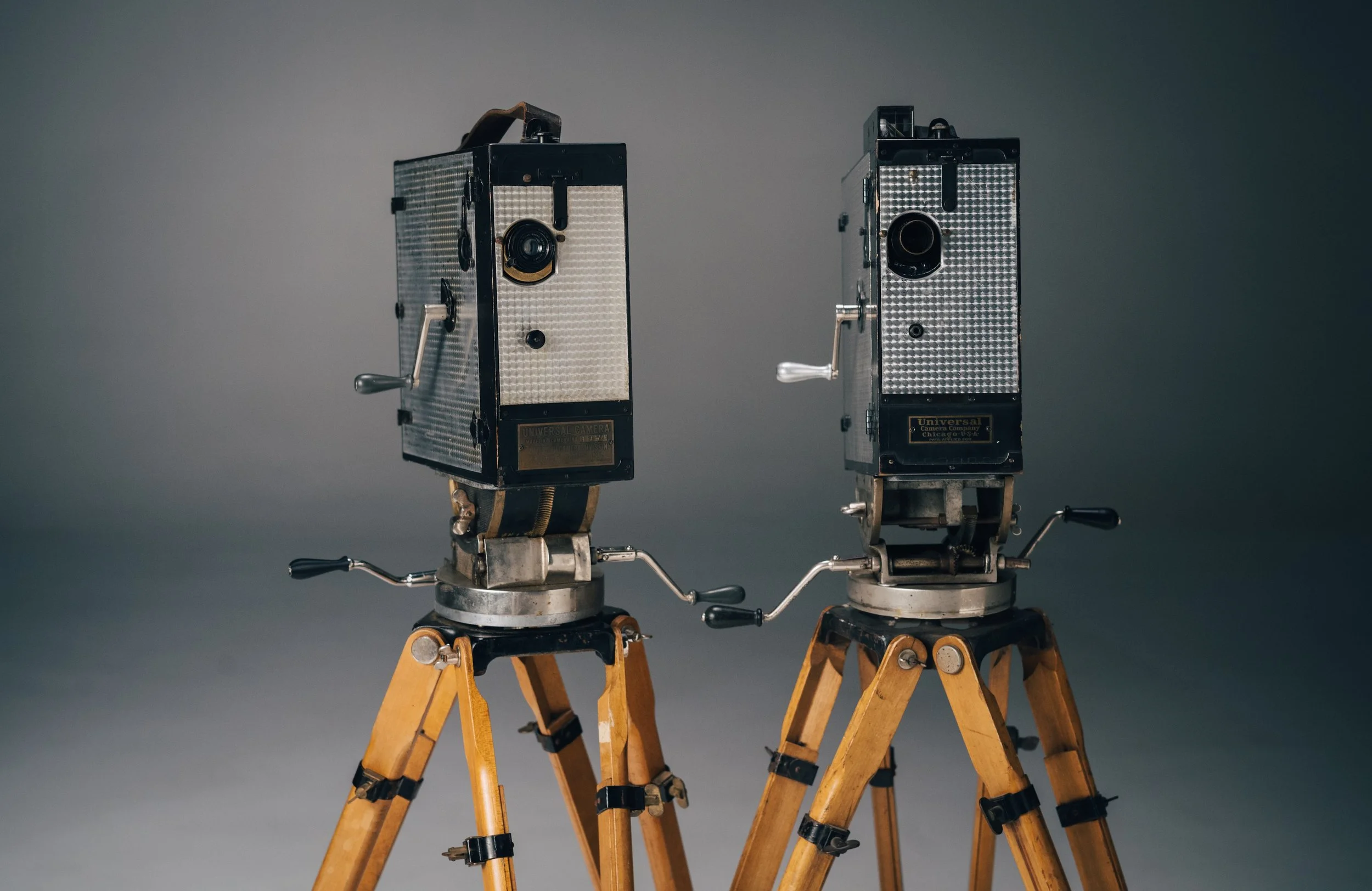
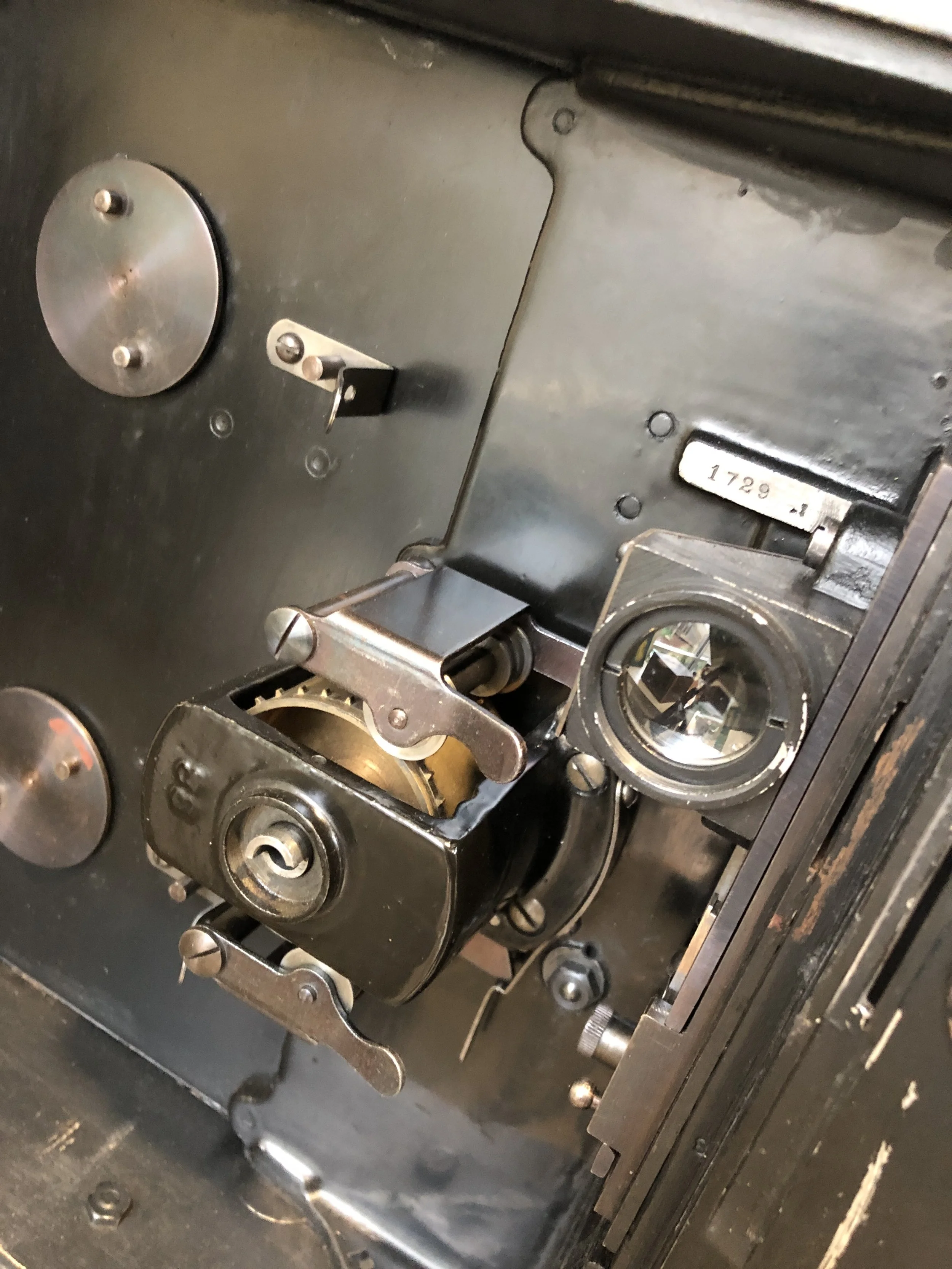
Universal No. 1729 and Universal Model A No. 2374
“The old camera that I used down here two years ago stood up as well as the new one, and outside of scars and scratches caused by long expeditions through the jungles and over mountains, it is as good as new — in fact, it’s like an old shoe, it is like a part of me, and I will always use it in preference to any other.”
The Universal Motion Picture Camera never had the glamour of the Bell & Howell 2709 or the romance of the Pathé studio cameras that were popular at the time. It was a workhorse — a hand-cranked, 35mm box of seasoned hardwood and reinforced aluminum, built in Chicago and sold to the people who actually went places: explorers, news cinematographers, industrial film makers, scientists, and the United States Army.
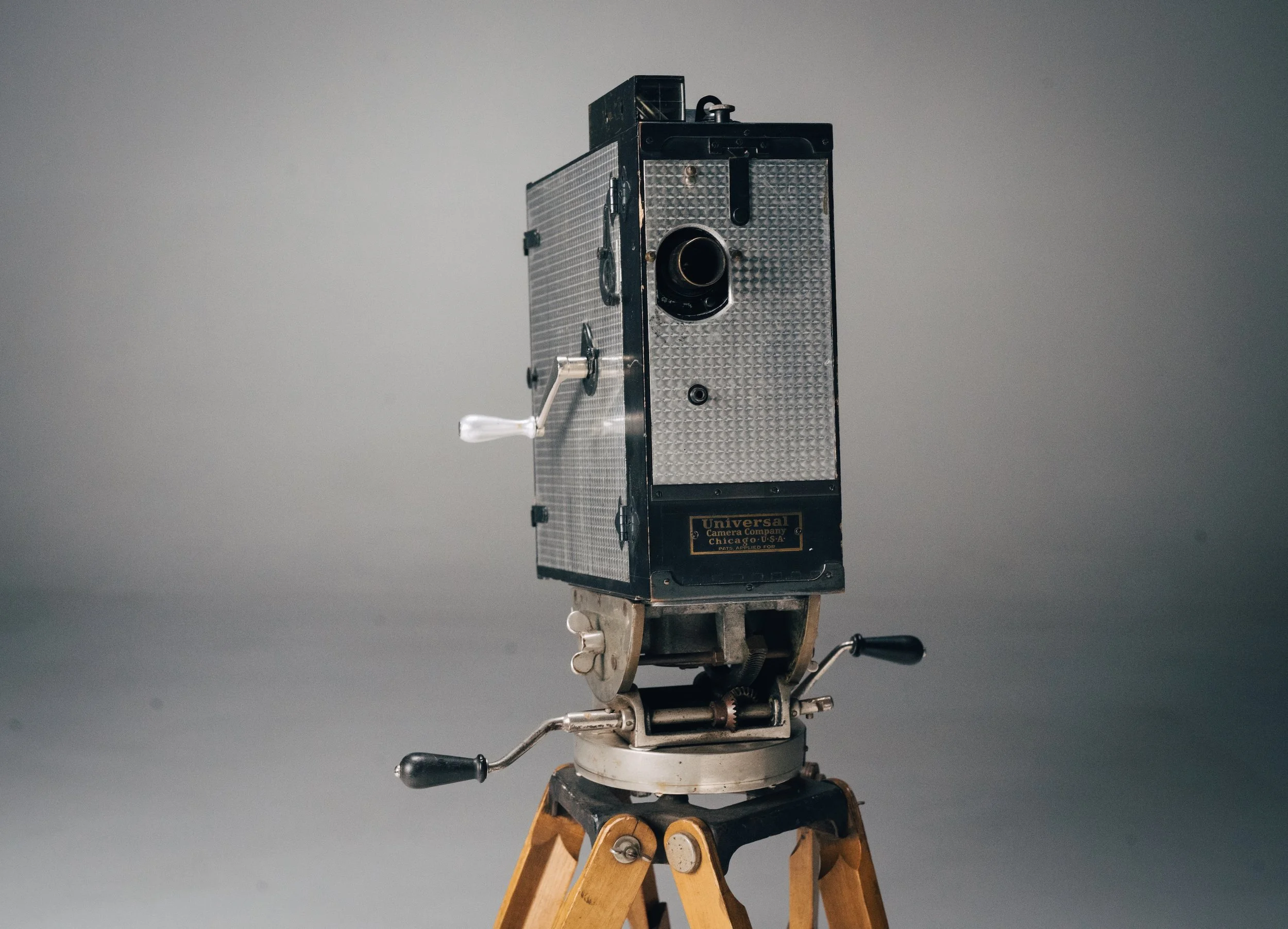
Early Universal No. 1729- Pats. Applied For [c. 1916]
Chicago, Not Hollywood
The camera had a specific Chicago pedigree. Its mechanical engineering was likely the work of Andrew Schustek, a Chicago machinist who had previously collaborated with Colonel William Selig to recreate the Lumière Cinématographe — the machine that became the foundation of the Selig Polyscope Company and one of America's first film studios. Schustek's designs drew on Lumière and Pathé mechanisms and incorporated some of the earliest aluminum components used in American motion picture cameras. A Schustek-made 35mm motion picture camera dated 1916 — the same year the Universal first appears in trade advertising — survives in the collection of the Autry Museum of the American West. When Selig's Chicago operations scaled down and shifted to California in the mid-to-late 1910s, Schustek carried his expertise to the Universal brand — and the camera Burke & James would sell to explorers and the newsreel men of the Western Front was, in this sense, a direct descendant of Chicago's first age of film.
The Universal was a product of Chicago's crowded photographic trade. It first appears in trade-press advertising in 1916, under the name of The Universal Camera Company of 25 E. Washington Street, with a New York office in the Times Building and West Coast representation through the Atlas Educational Film Company of San Francisco. Patent dates on surviving cameras run from August 1918 to April 1923, and the camera itself was already established enough by the war years to be picked up by the U.S. Government.
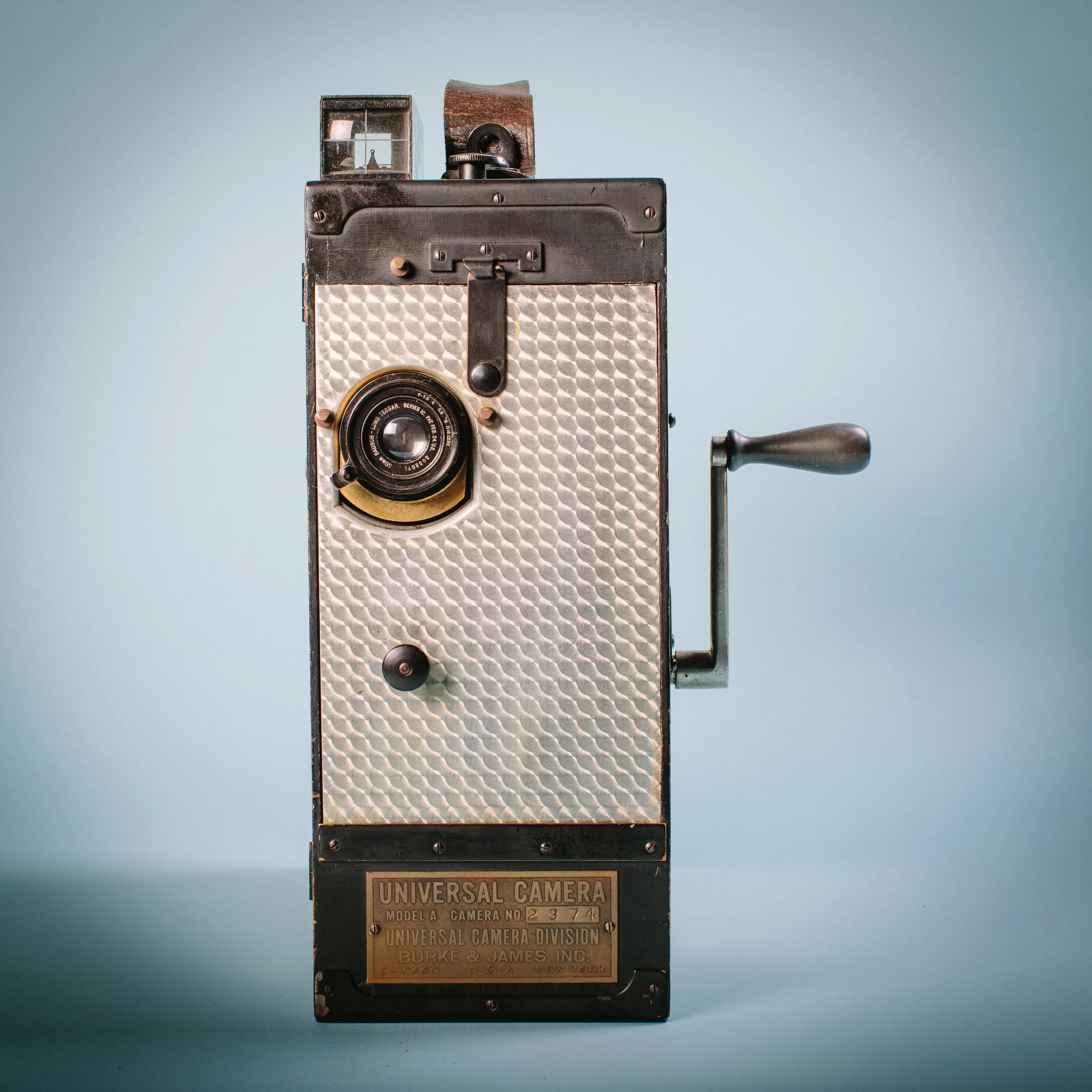
Burke & James Universal Camera c.1918
In 1917, Burke & James, Inc. — the big Chicago photographic house founded in 1897 — took over as the exclusive wholesale selling agency for the Universal Camera Company's products, including its cameras, tripods, and dissolvers, as reported in The Camera in the January, 1917 issue.
Martin Johnson's November 1919 letter, addressed to "Universal Camera Company, care of Burke and James," reflects that arrangement — and by the 1921 booklet, Burke & James appears alone as manufacturer, the line having passed fully into its hands. Burke & James had built its business on sturdy, affordable equipment — its Rexo line of folding cameras was advertised under the slogan "Quality Cameras at Prices Within the Reach of All" — and by the mid-1910s the firm had grown into a substantial operation, manufacturing at 240-258 E. Ontario Street on Chicago's near north side with a branch office at 225 Fifth Avenue, New York. The company ran the Universal through its "Cine Department," and its advertising of 1919–1921 promoted the camera relentlessly in the photographic press.
The Universal Camera Company should not be confused with the Universal Camera Corporation of New York, the maker of the bakelite Univex cameras and 8mm cine camera, which wasn't founded until 1932 — nor with Universal Pictures. The name was simply too good for one company to keep.
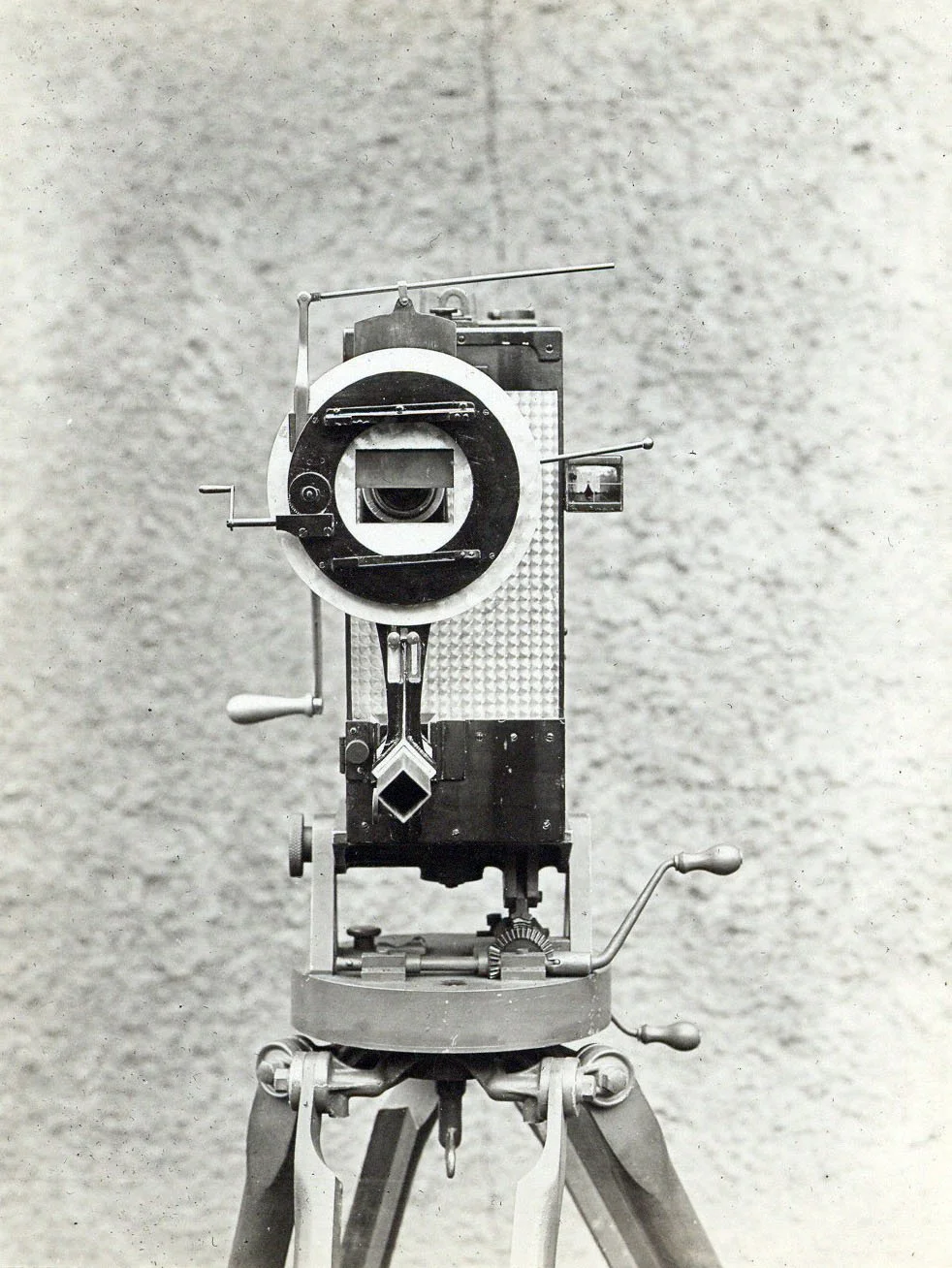
“Each camera is actually built by instrument makers; each has the precision and adjustment of a watch; each has a strength and ruggedness that enables it to stand the hard wear and usage to which the Universal may be subjected on the far trails and lonely places of the world where it is the trusty ‘recording eye’ of the explorer, the traveller and the alert news photographer.”
One Casting, One Gear

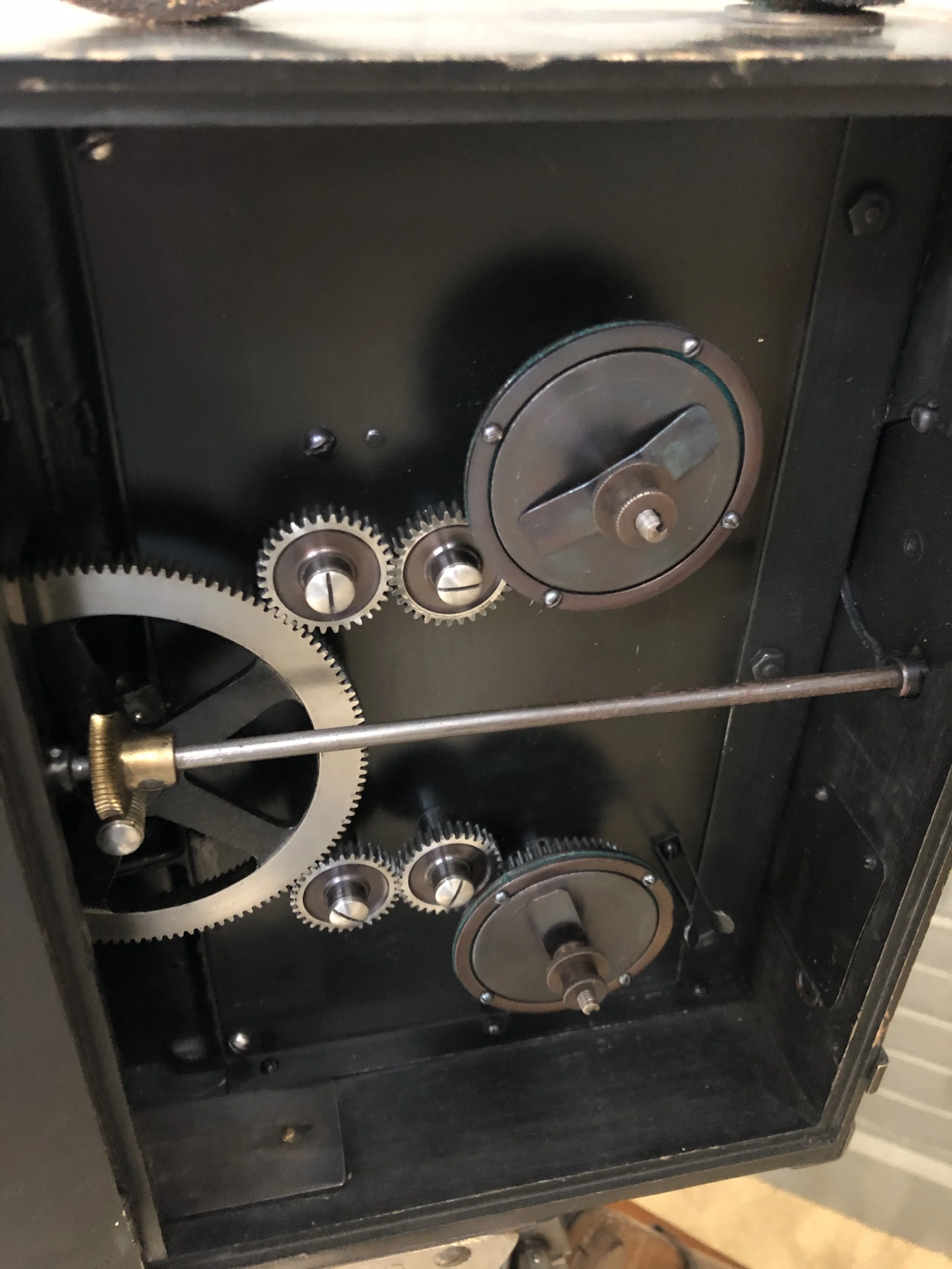
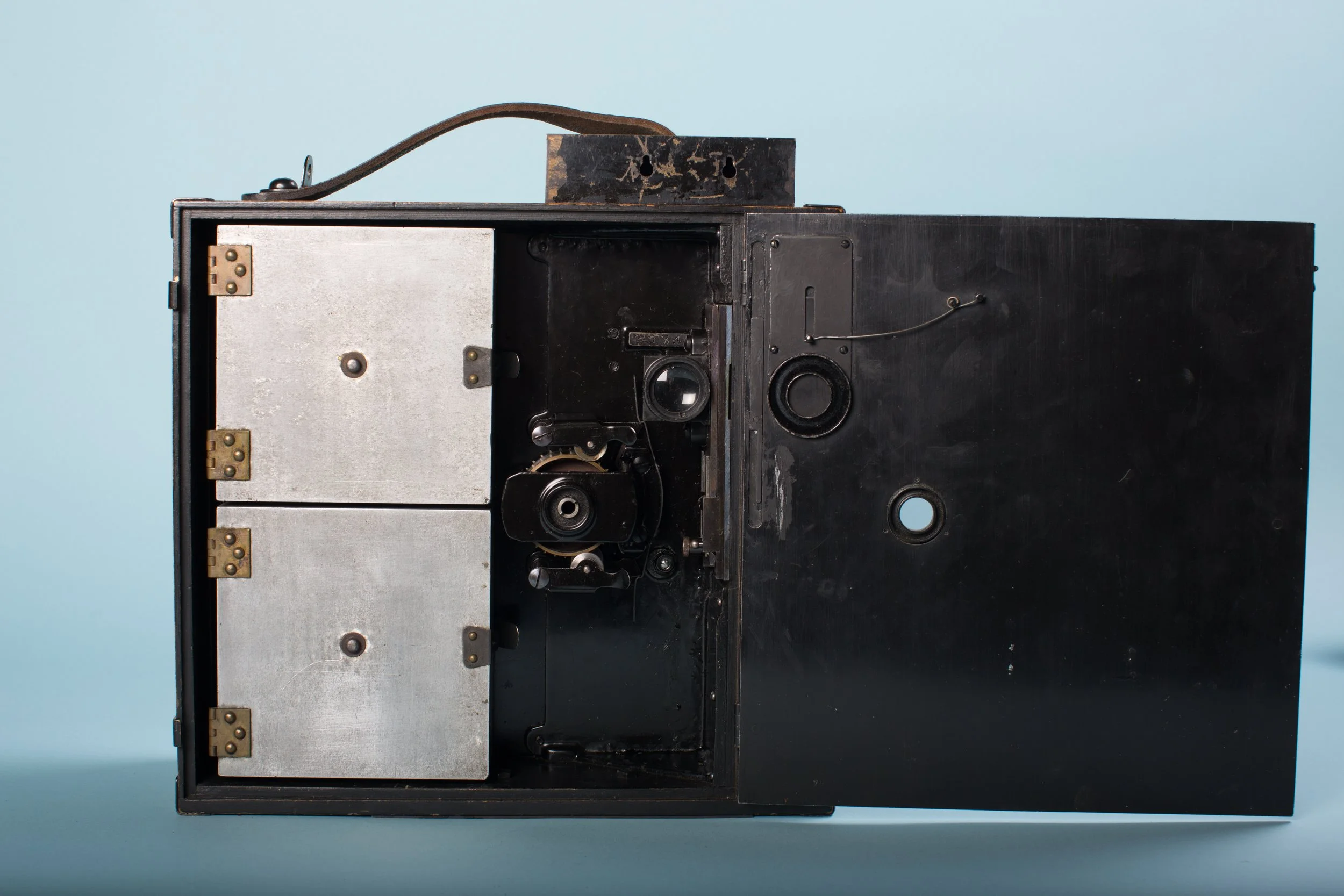
The engineering philosophy of the Universal can be stated in a sentence: attach everything to one thing, and drive everything from one thing. Every moving part was mounted directly to a single main casting, which protected the optical alignment against rough handling and climate. And every moving part was driven from a single large master gear — shutter, shuttle, sprockets, take-up — all turning in permanent unison.
“The mechanism of the Universal Camera is as carefully and scientifically constructed as the movement of a standard watch. There is one large master gear from which all moving parts are driven. This centralization of power simplifies the machine, gives the highest efficiency, and makes every piece accessible.”
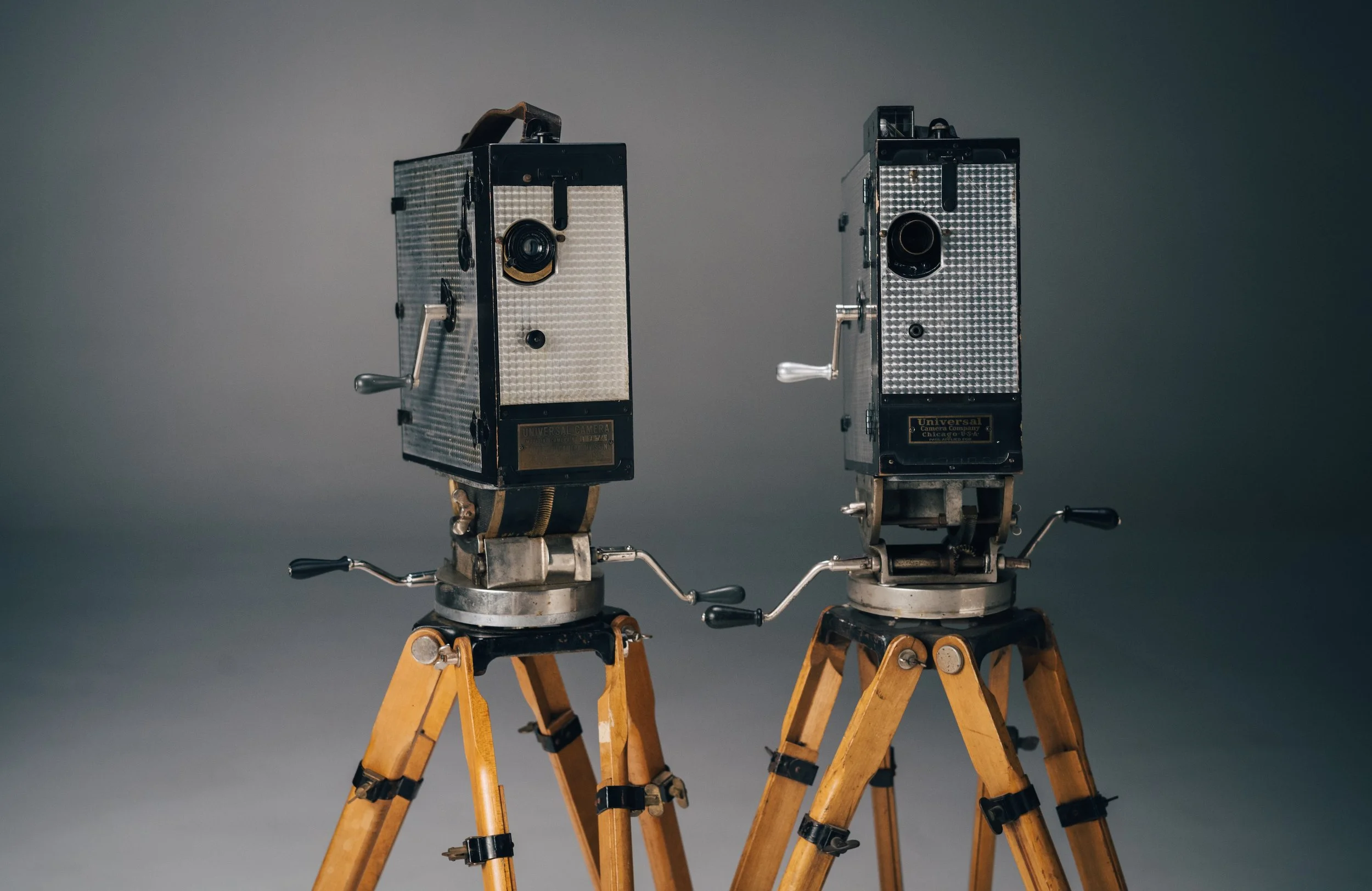
The case was reinforced aluminum and selected, seasoned hardwood under waterproof enamel, with latches that needed no key. The 200-foot camera measured a compact 4¾ × 11 × 12 inches and weighed just 21 pounds. Film registration came from an intermittent shuttle driven by a hardened steel cam off the balance-wheel shaft; the film channel opened like a gate, with polished steel tension shoes and a self-adjusting side rail.
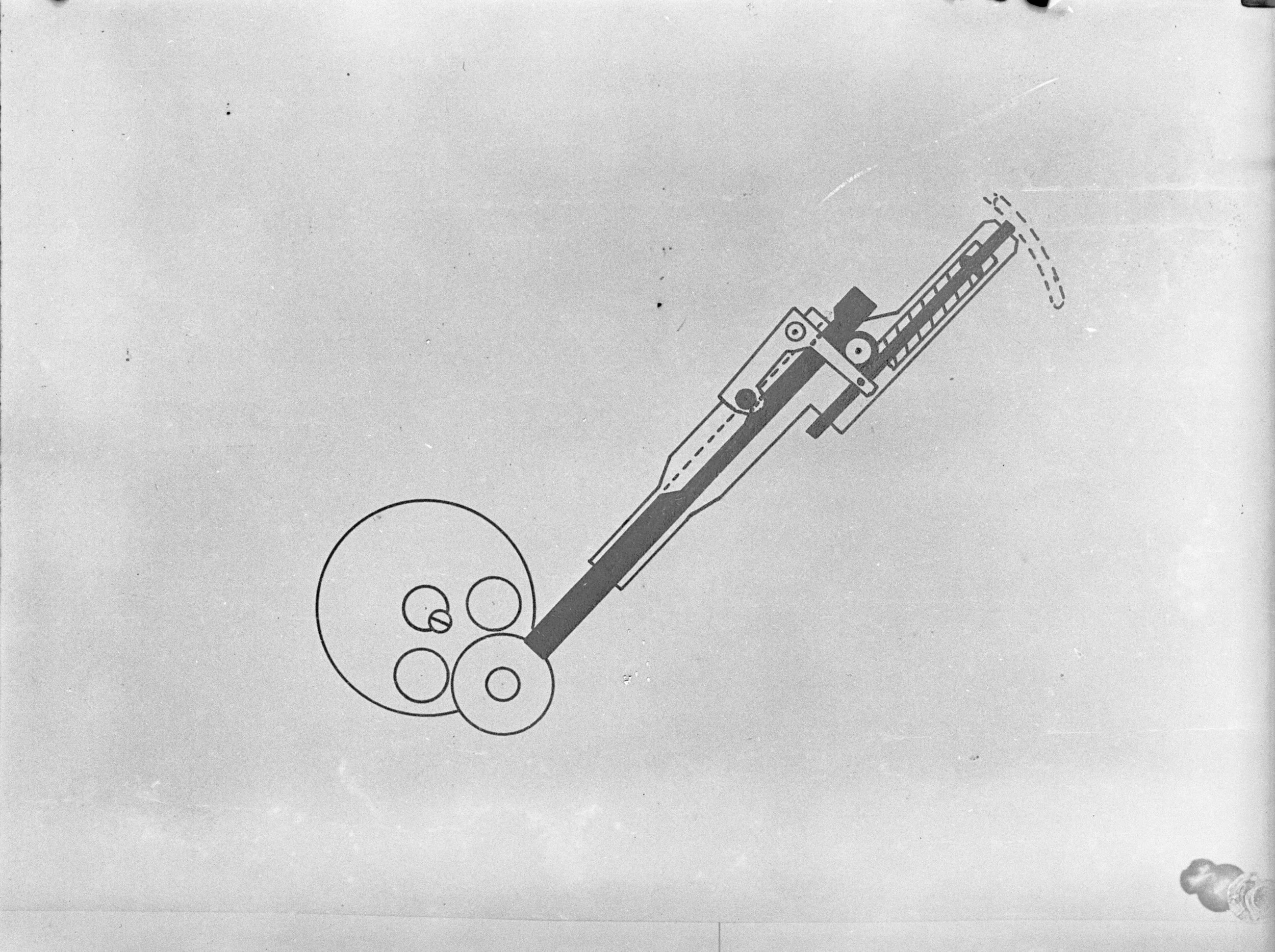
Diagram of a Universal Camera
The all-metal drive train had a side benefit the catalog was happy to point out: no static. Static discharge — those lightning-like flashes fogging film in dry weather — plagued early cameras. The Universal's metal construction kept the whole machine grounded through the body of the operator.
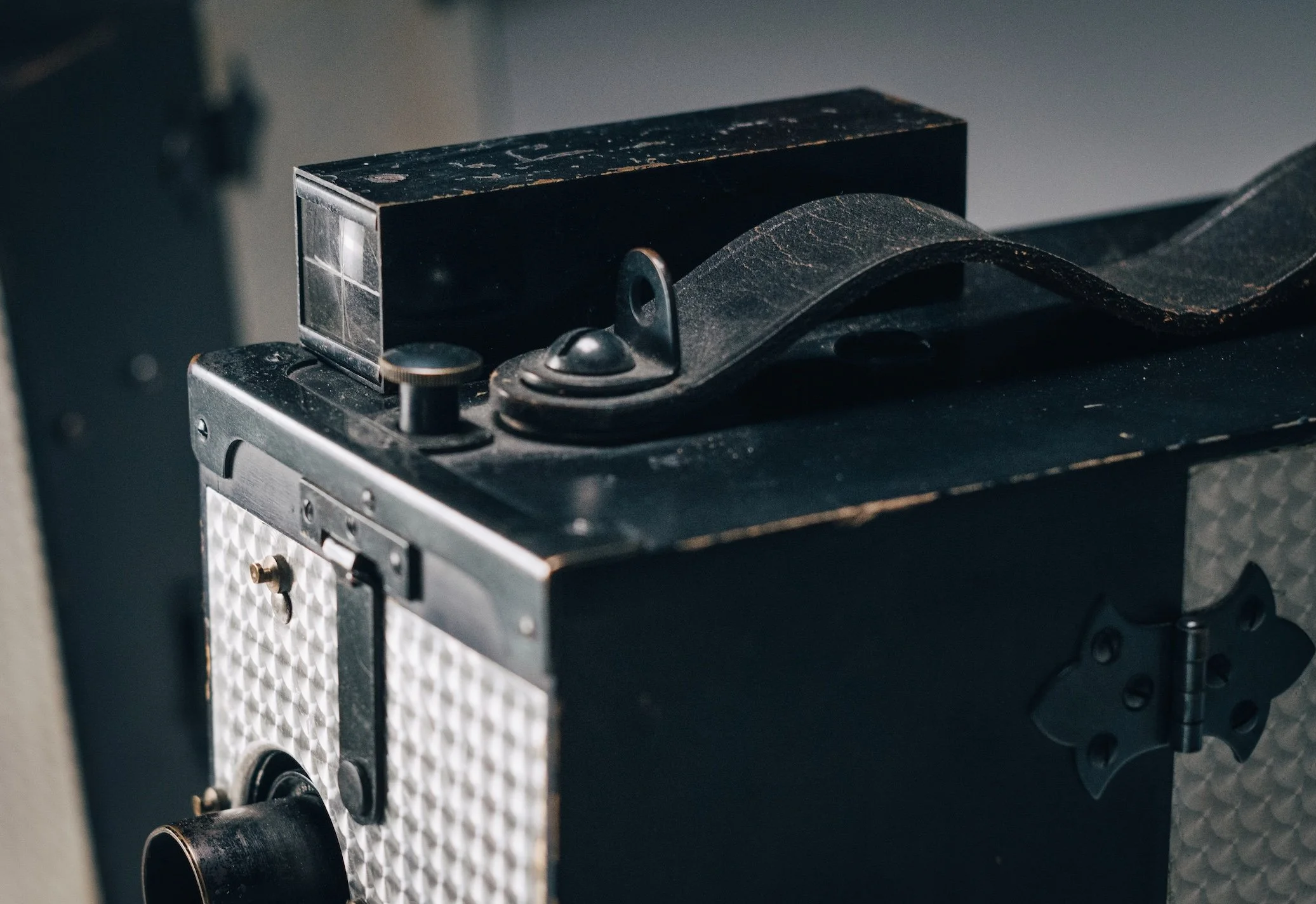
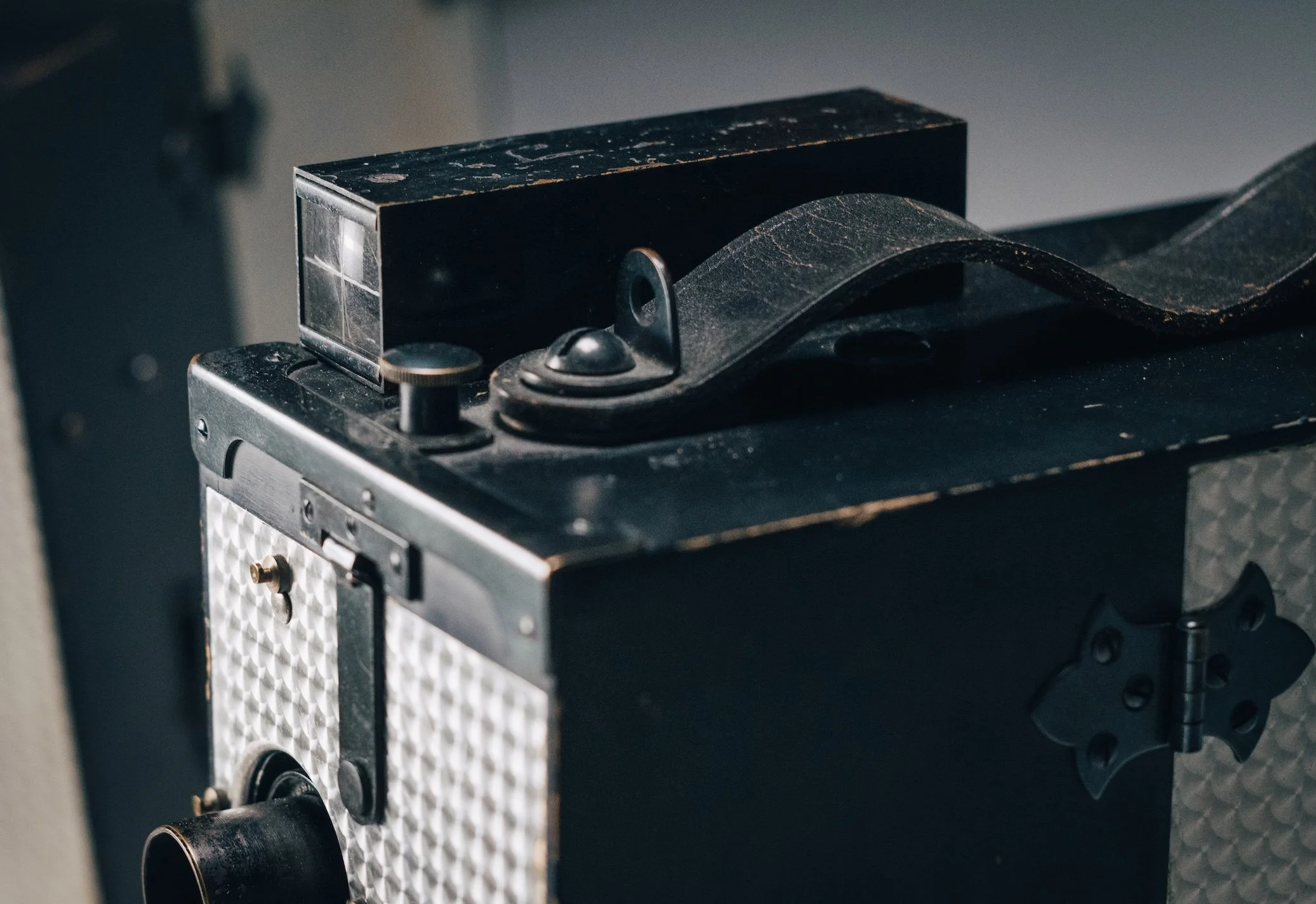
Removable Finder mounted on top or side
The feature list, as Burke & James gave it:
Built for long, hard usage — light in weight, no bulky protruding parts
Quick change, positive locking lens adapter
Built-in shutter dissolve for fades and double exposures
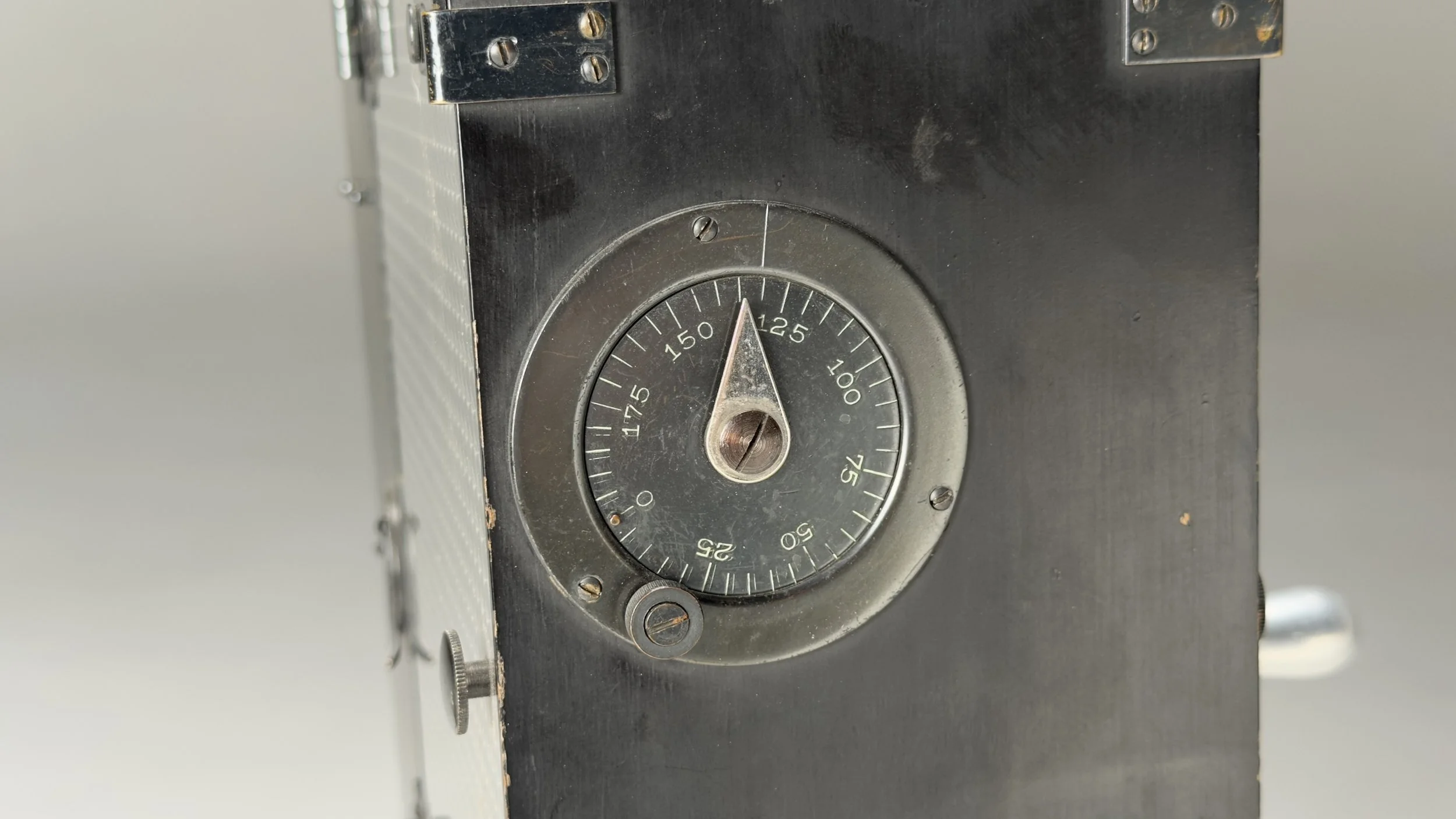
Double dial footage gauge — total footage and footage of the last scene
Large master gear operating all moving parts in perfect unison
Adjustable framing device to position the image relative to the film perforations
Positive-action take-up with friction disc tensions
Crank revolution counter and prism focusing tube
Some of these deserve a closer look. The optional built-in dissolve let the operator fade out by closing the variable shutter while cranking, then — using the crank counter — wind the film back the exact number of turns and fade in on a second exposure. Six interchangeable mask plates, inserted from outside the camera without exposing film, expanded the repertoire of effects. Cranking backward produced reverse motion for "specials, composites, dream and trick pictures," and a one-frame-per-turn trick shaft handled stop motion.
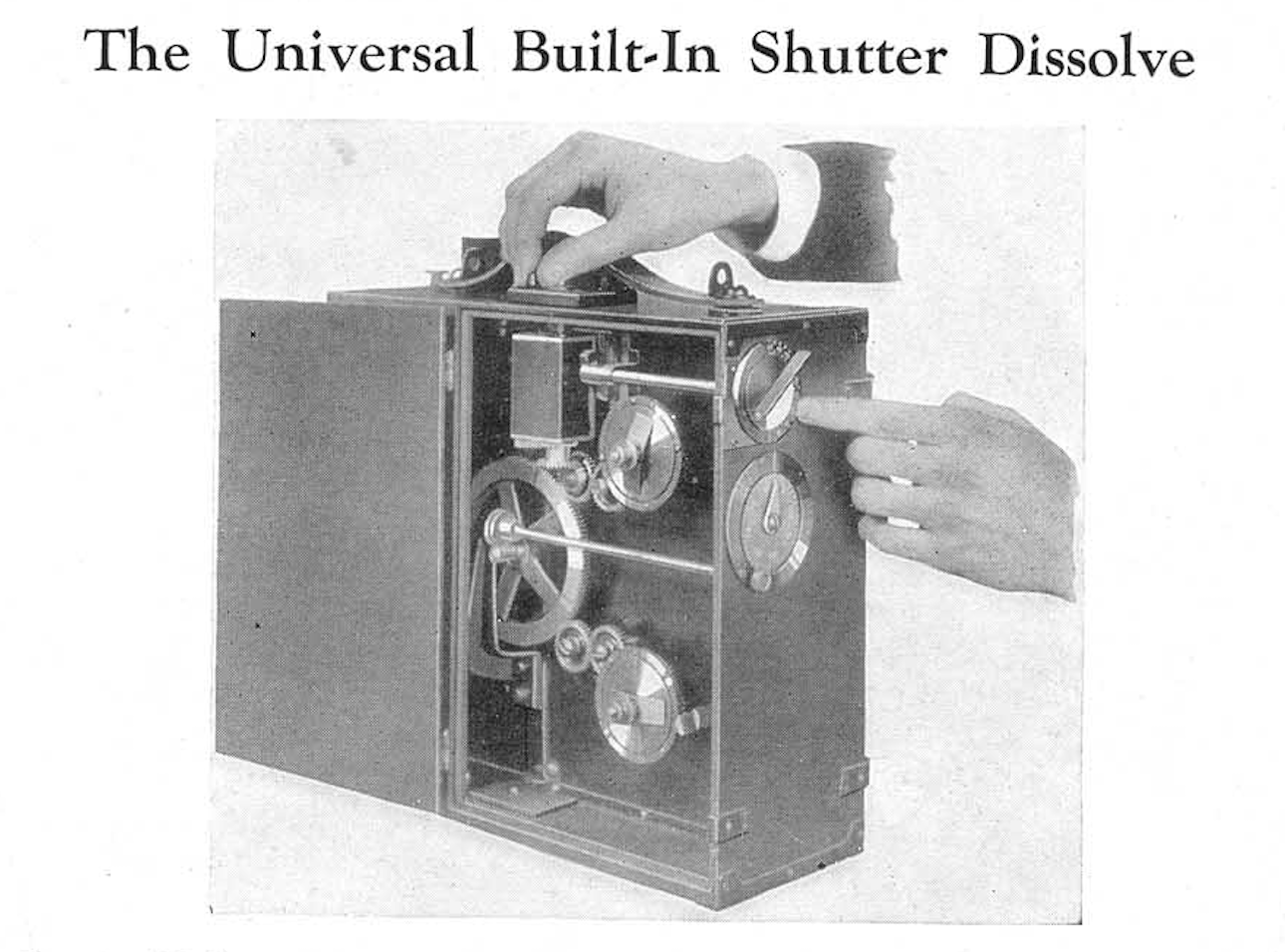
The framing adjustment solved a real industry problem: some producers demanded the image framed level with the perforations, others halfway between. The Universal could match either standard instantly — a "universal" machine in the literal sense.
Loading was a particular point of pride. The aluminum 200-foot magazines were interchangeable, and threading took less than a minute — requiring only 20 inches of leader film where other cameras wasted three to four feet. At 1919 film prices, that was an argument that paid for itself.
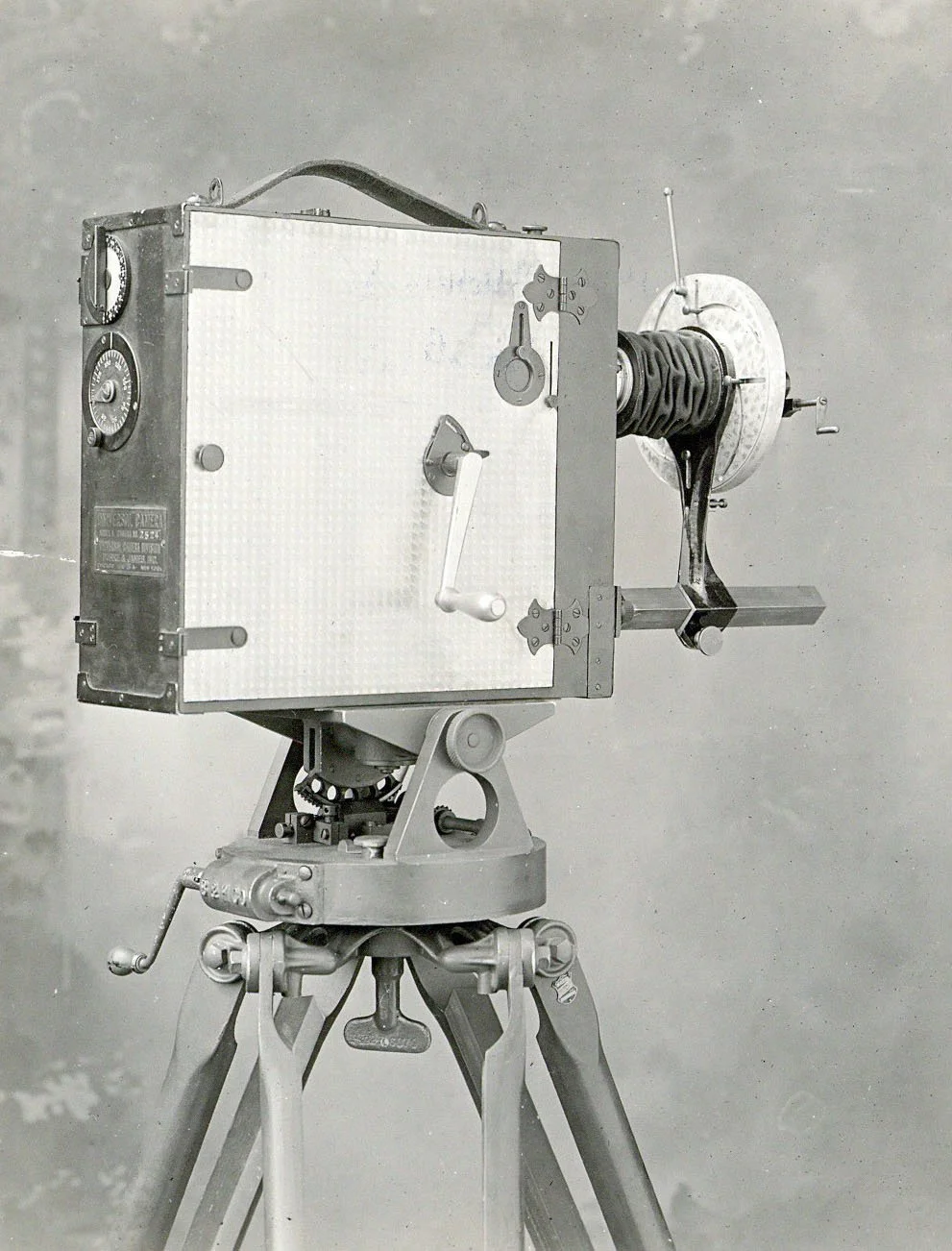
Universal Promotional Image
The 400-Foot Model and the War
The camera ran at the standard sixteen frames per second — two crank revolutions per second, one foot of film per second, sixty feet a minute. For longer takes, Burke & James offered the 400-foot Universal (4¾ × 14¼ × 15 inches, 28 pounds), recommended for studio work — and carrying a wartime pedigree the catalog made the most of: it was, they wrote, "the model which was chosen by the United States Government for overseas use during the world war, the Universal being the only camera which was so built that it would stand the rough usage to which a motion picture camera must be put during actual warfare." The booklet elsewhere notes a Universal at work "in a dug-out on the French battle front."
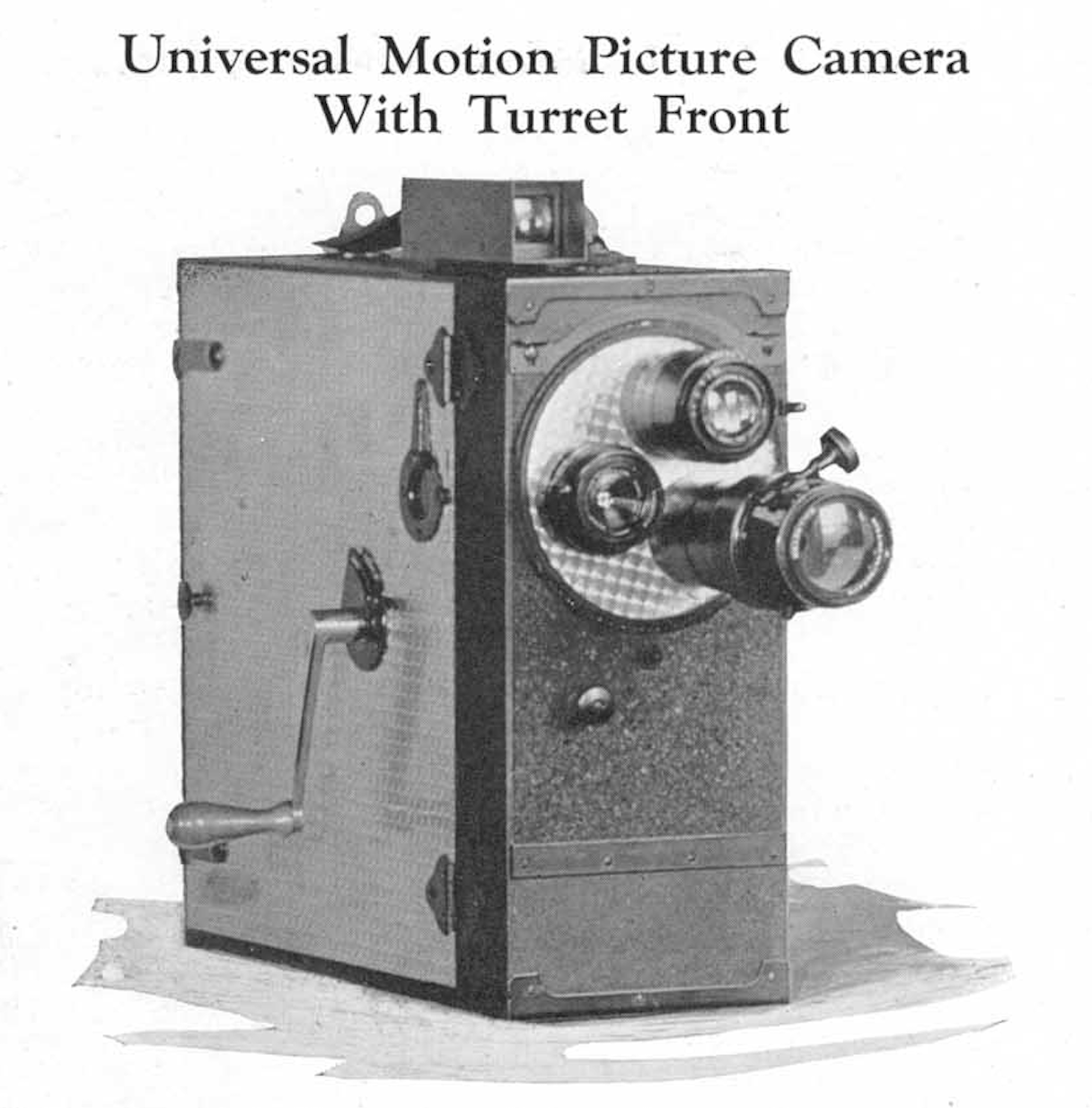
Both models could be had with a revolving turret front carrying three lenses of varying focal lengths from 32mm up, paired with the Universal Triple Focus Masking Finder — an unusually advanced specification for a field camera of this date.
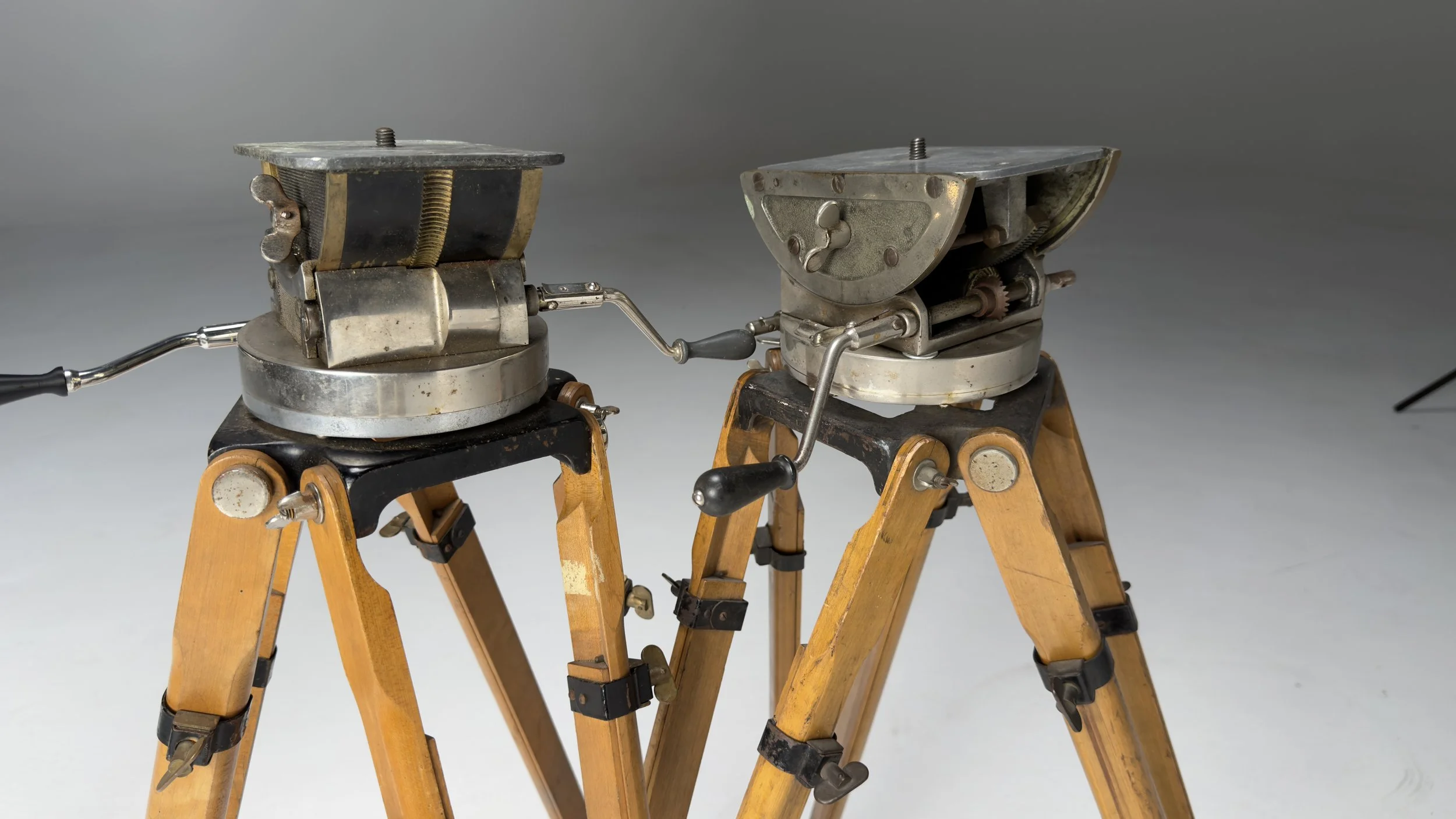
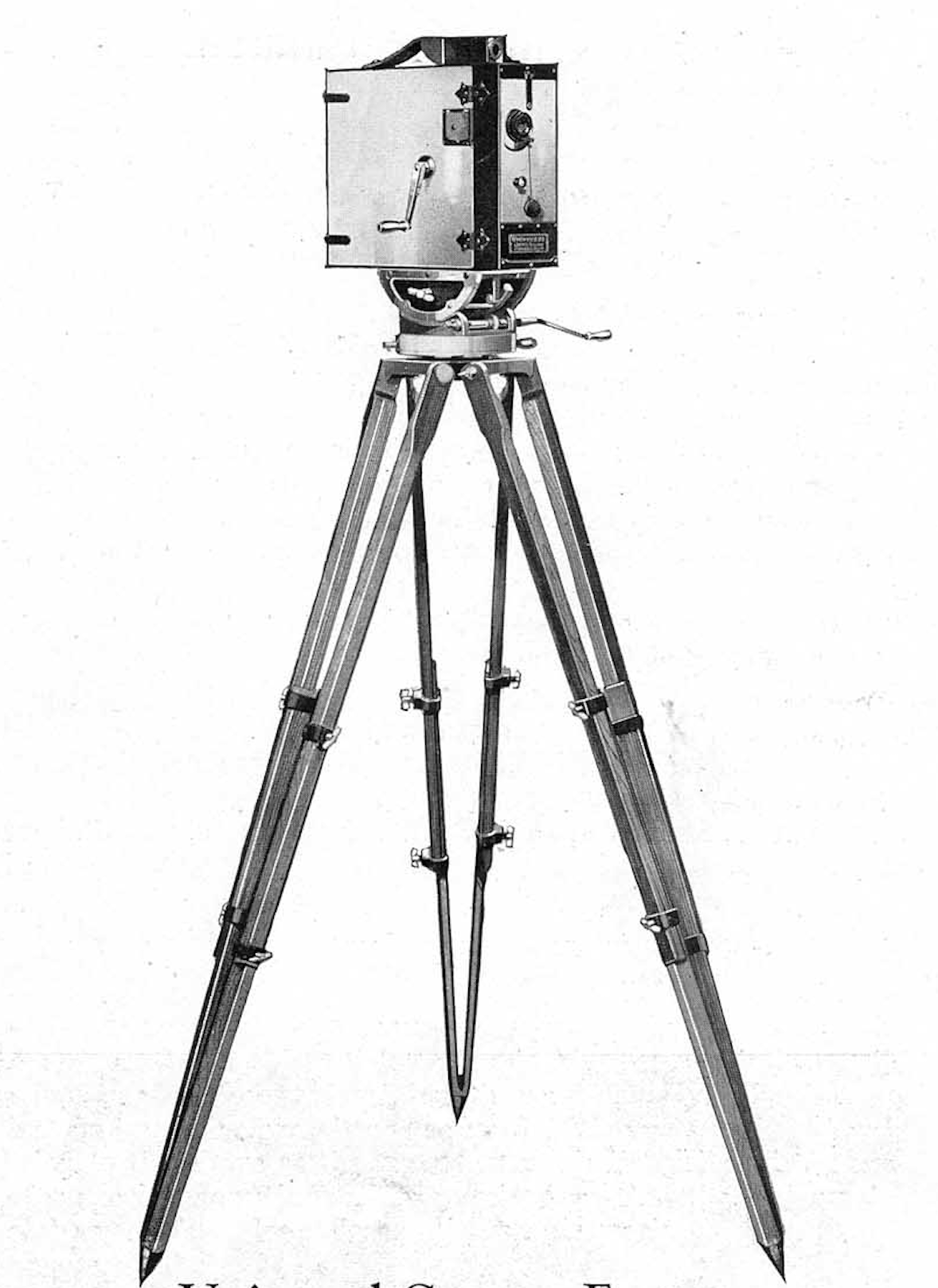
The Tilting and Panoramic Tripod
A hand-cranked camera is only as good as what it stands on, and the Universal's tripod was promoted nearly as hard as the camera itself. The Universal Camera Company's early advertising for it had a swagger all its own: "If your Panoramic and Tilting Tripod is not as good as this one — you are working at a disadvantage... Shall we prove it?"
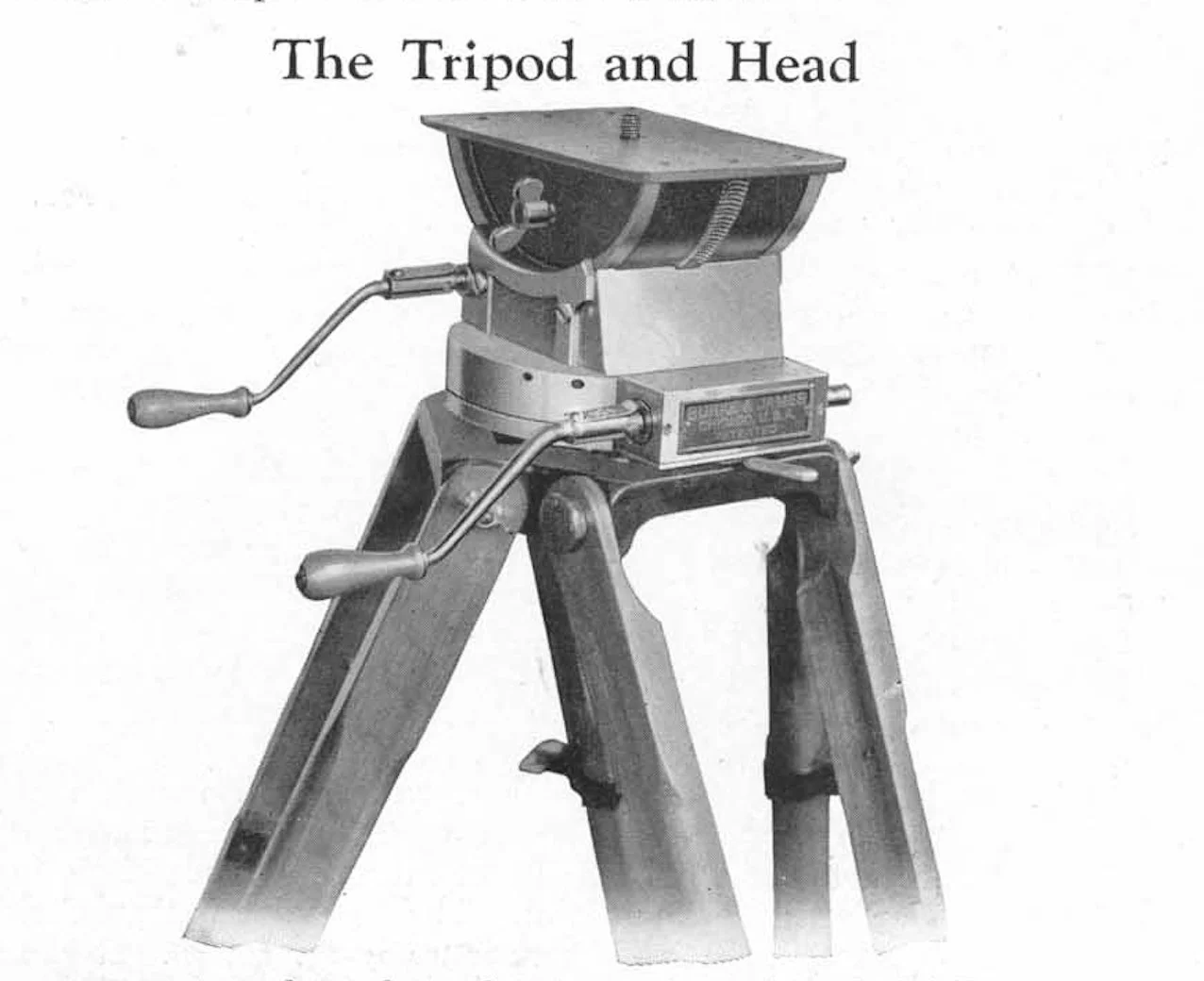
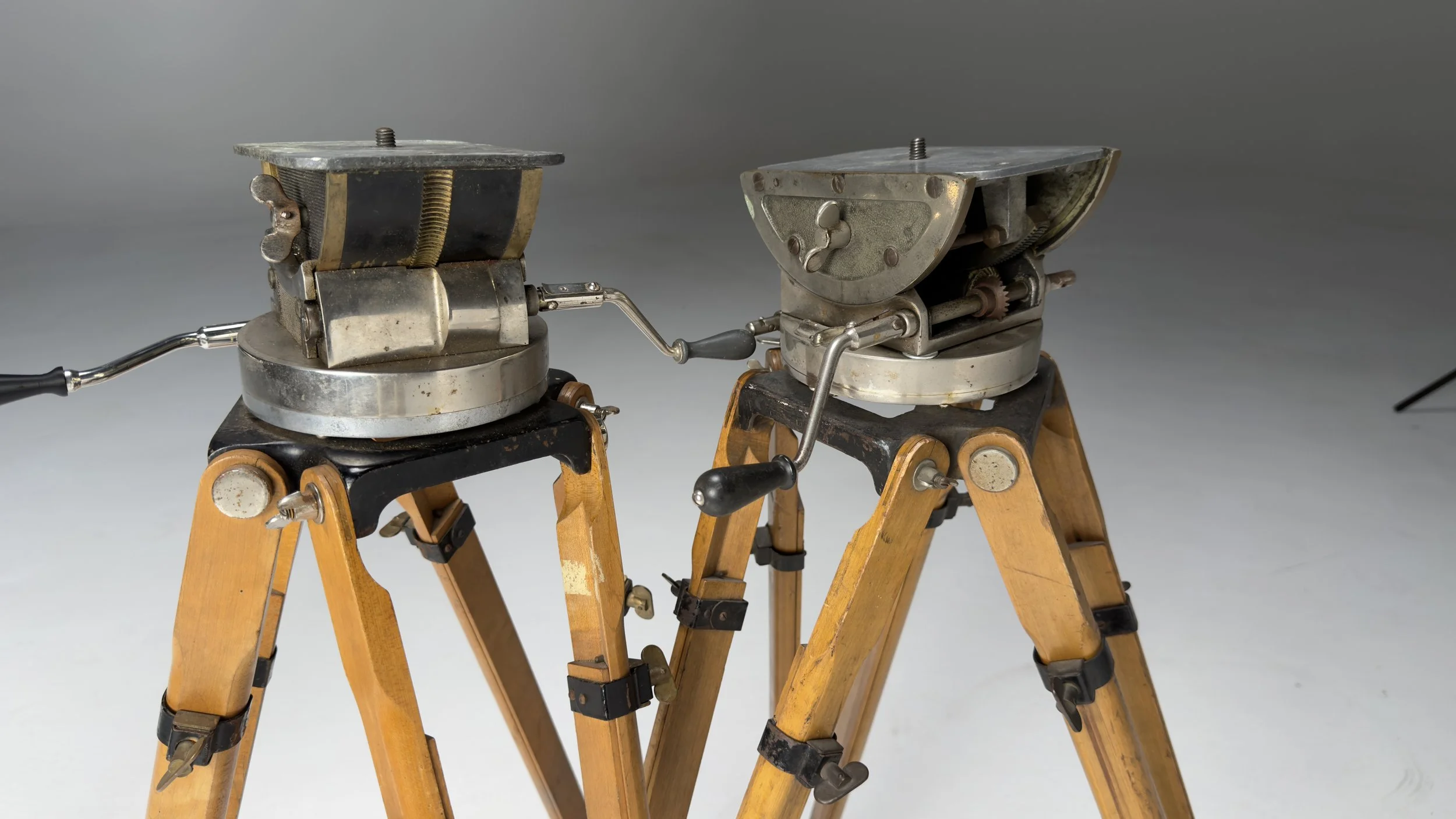
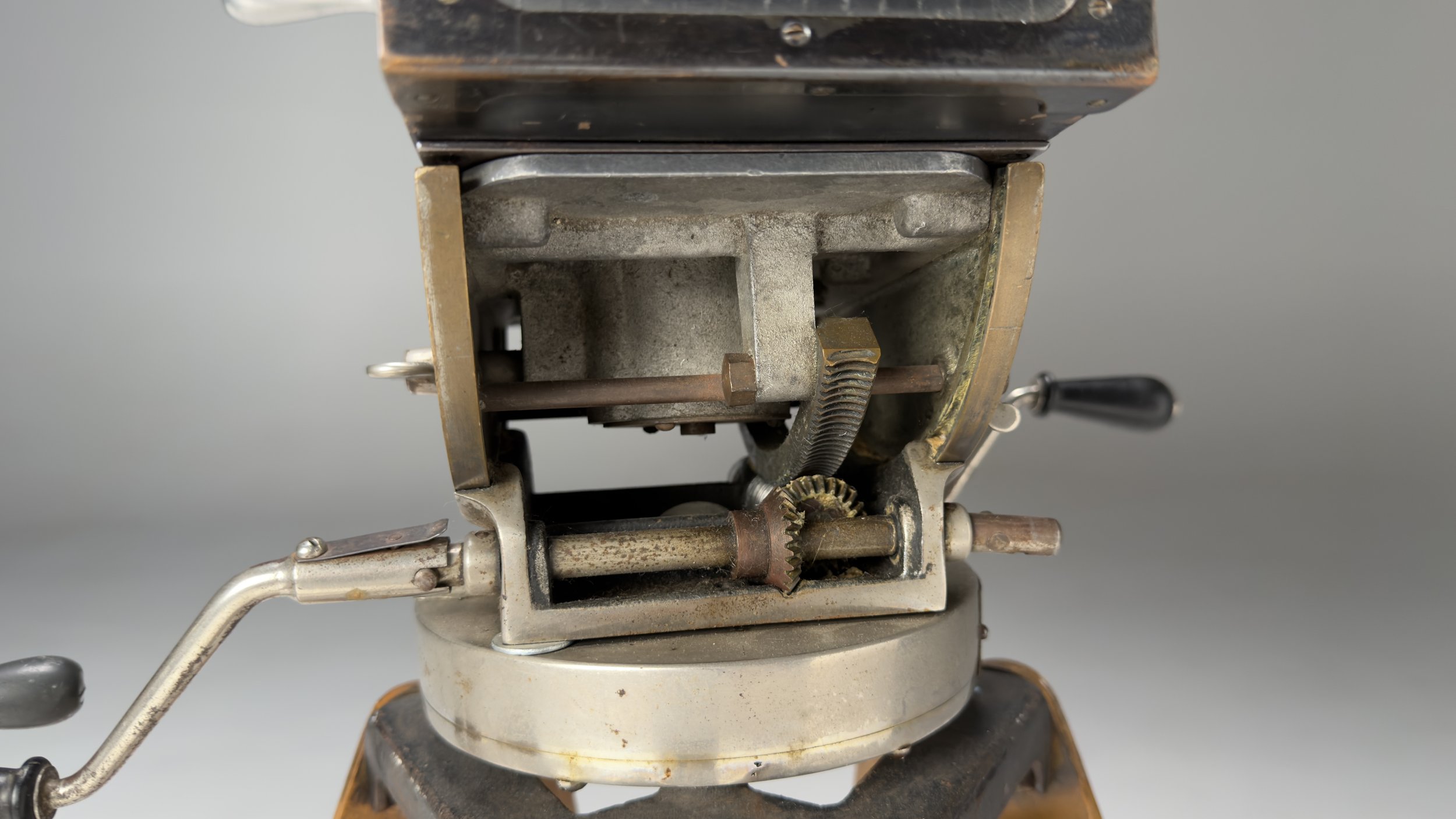
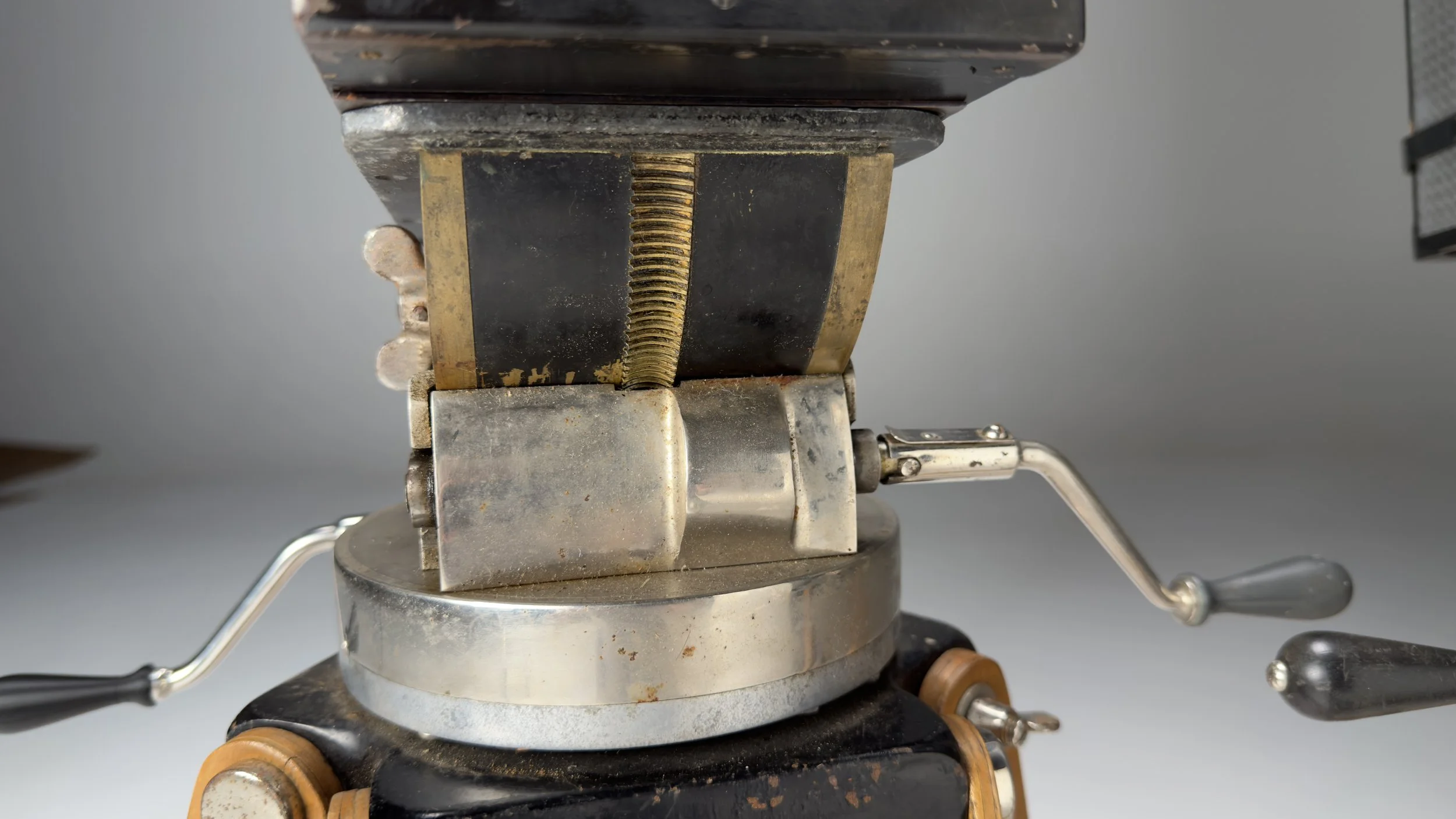
Its defining feature was the vertical tilt. Where competing heads pivoted on a simple hinge, the Universal used a segmental slide of the company's own invention — a curved, grooved cradle in which the full weight of the camera rode on the base piece at all times. The result was a smooth, steady tilt through 90 degrees with none of the twitching and jerky action of pivot heads. The panoramic movement ran on deep-cut worm gears that could be instantly disengaged for fast repositioning, then locked against accidental movement.
The details were thought through with the news man in mind. The automatic lock bolt was operated from the side of the head rather than underneath, with a compression screw depressed by the camera's own weight — a Universal could be mounted on the tripod in ten seconds, and a click told you it was free when dismounting. Wide-spread top legs gave truss strength; snap handles could not fall off.
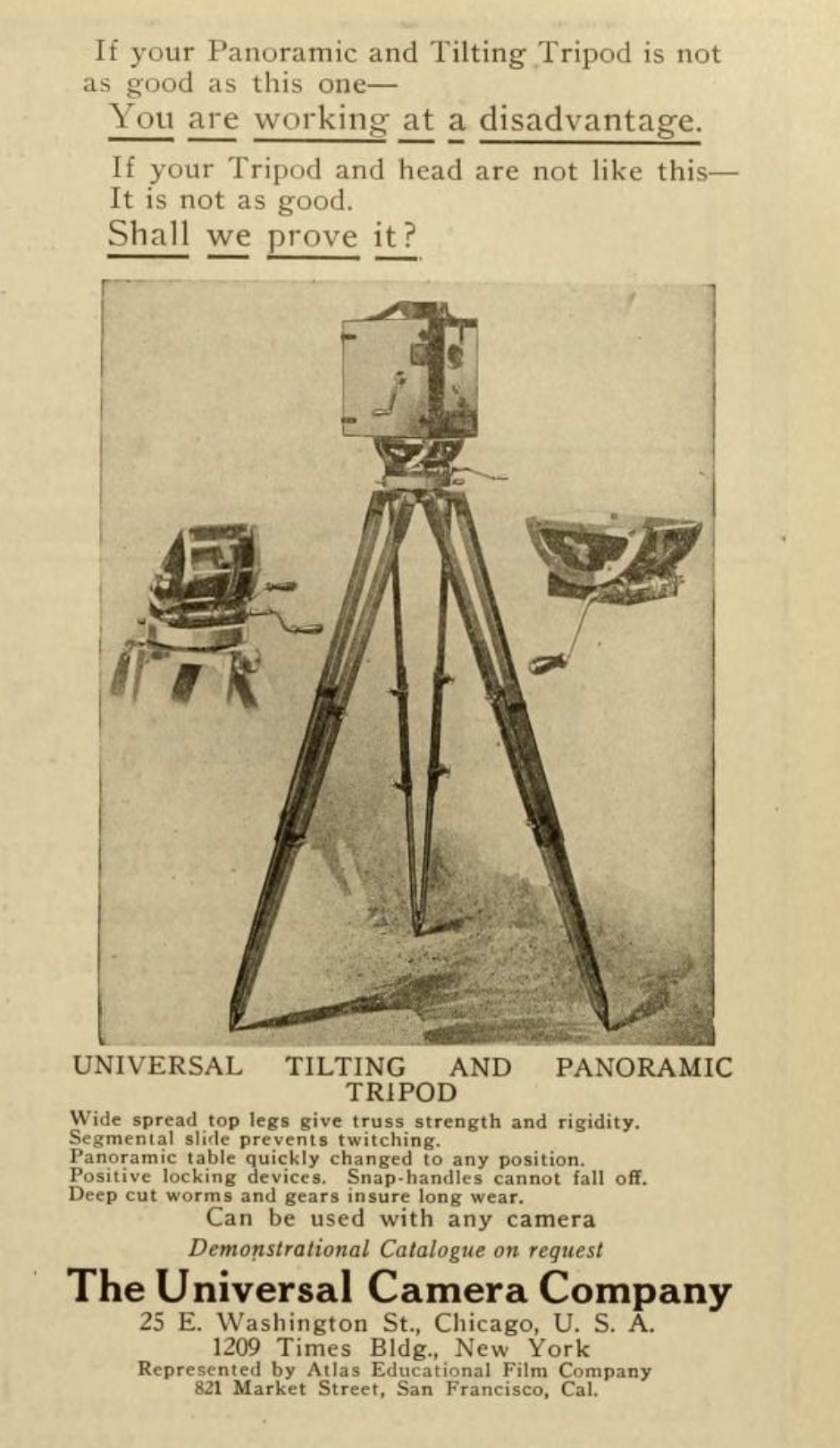
The Universal Tilting and Panoramic Tripod
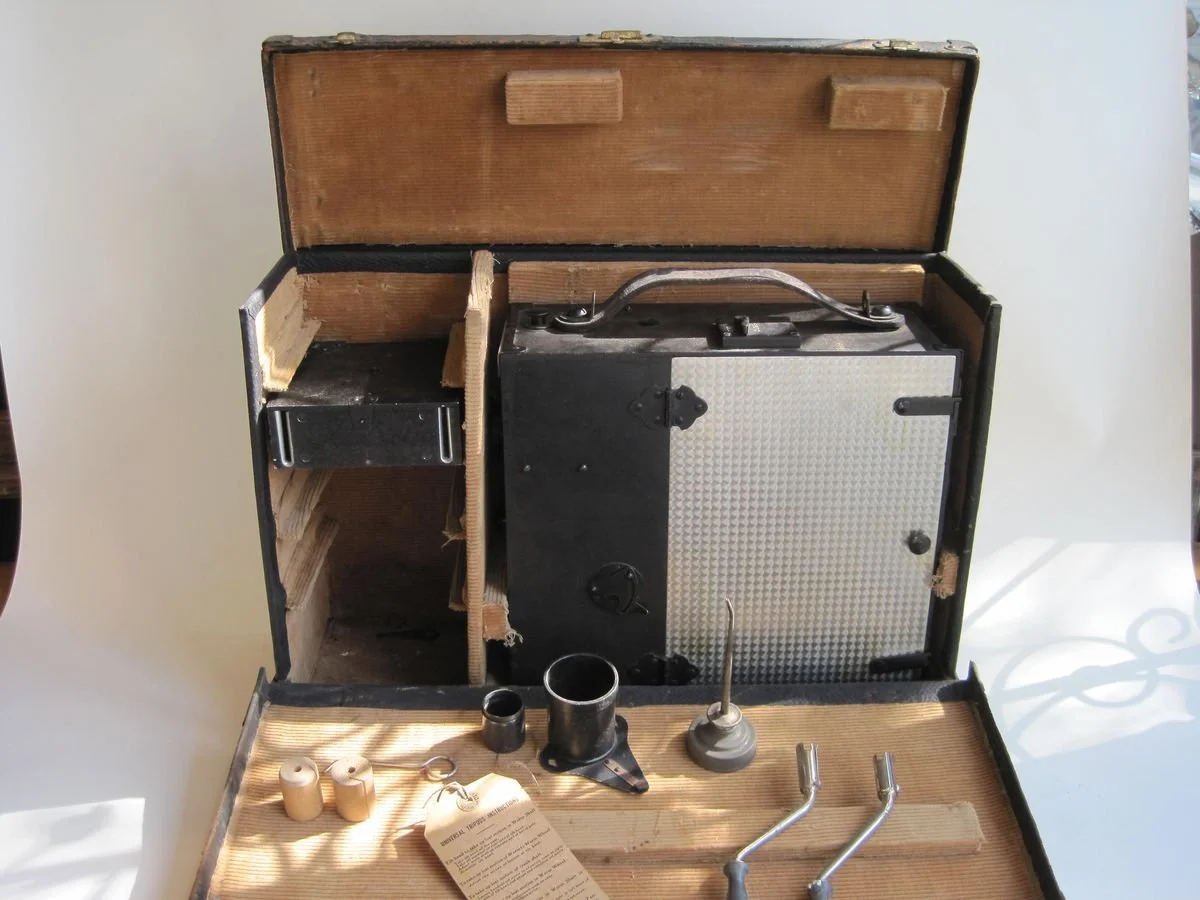
The complete tripod weighed 20 pounds and cost $100, and the camera and tripod cases were deliberately weighted to balance each other, one in each hand.
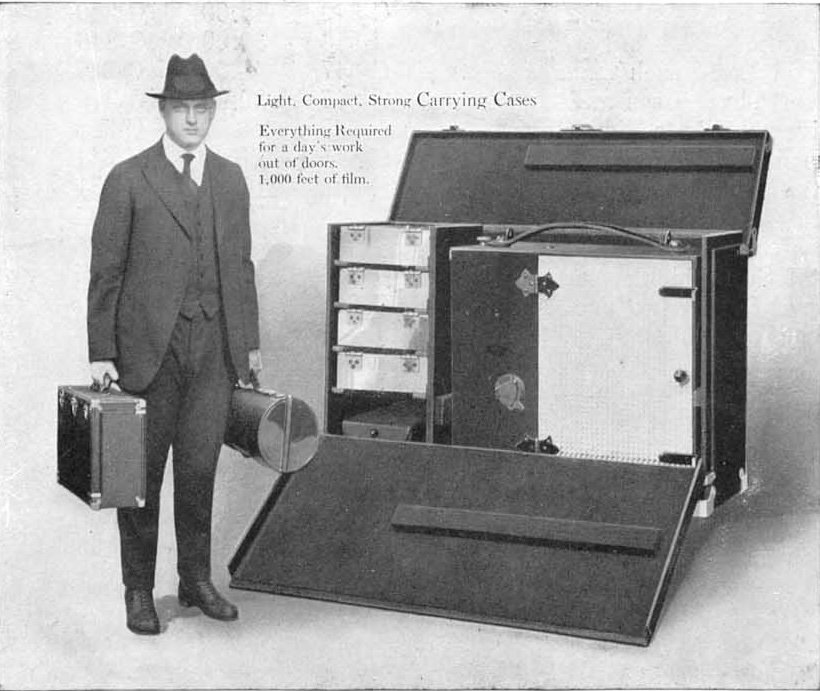
Light. Compact. Strong. Carry Cases
Burke & James also sold the tilting head separately, pitching it as an upgrade for "old and more limited machines" — it could be fitted to any camera on the market.
Variations
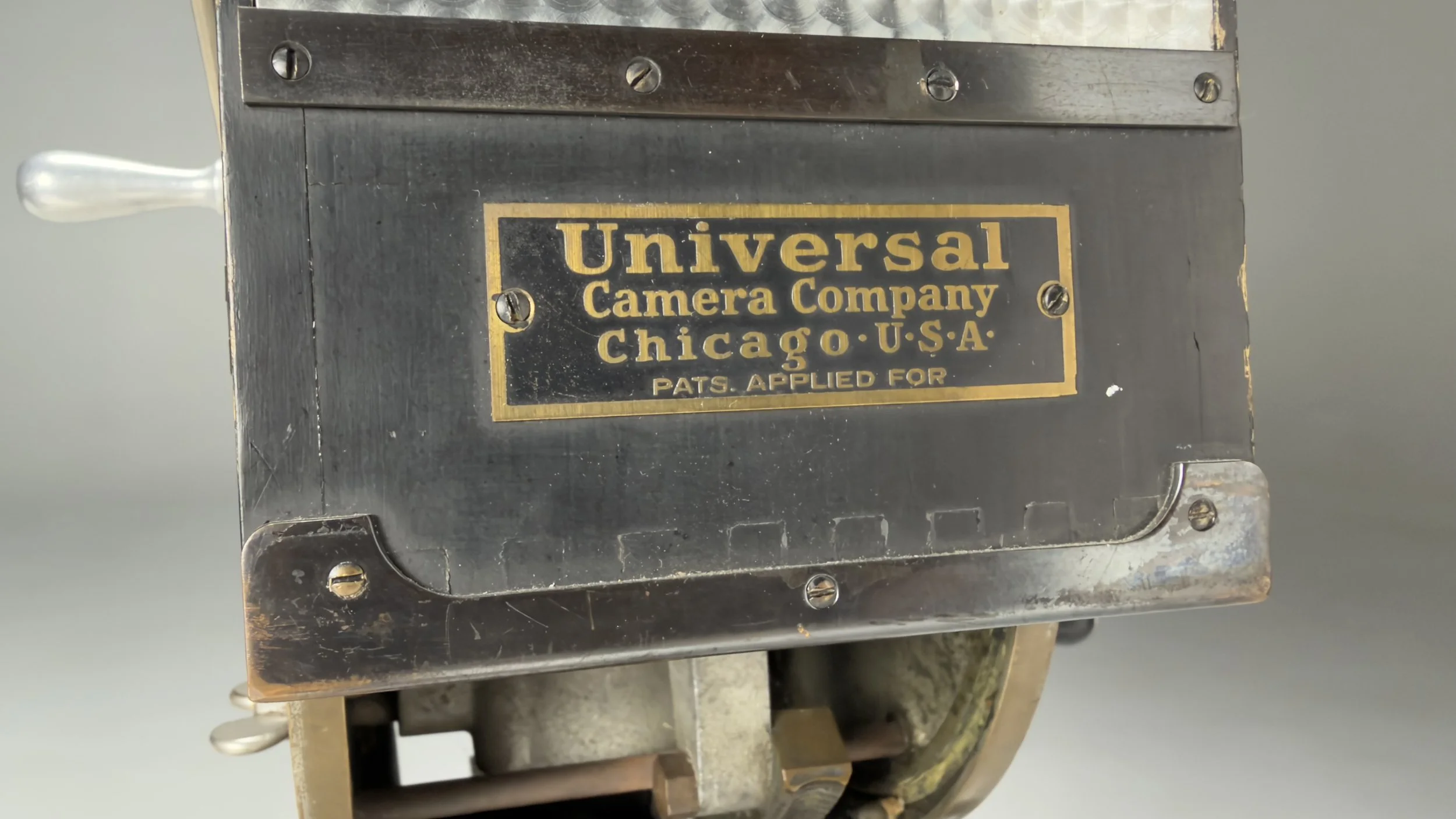
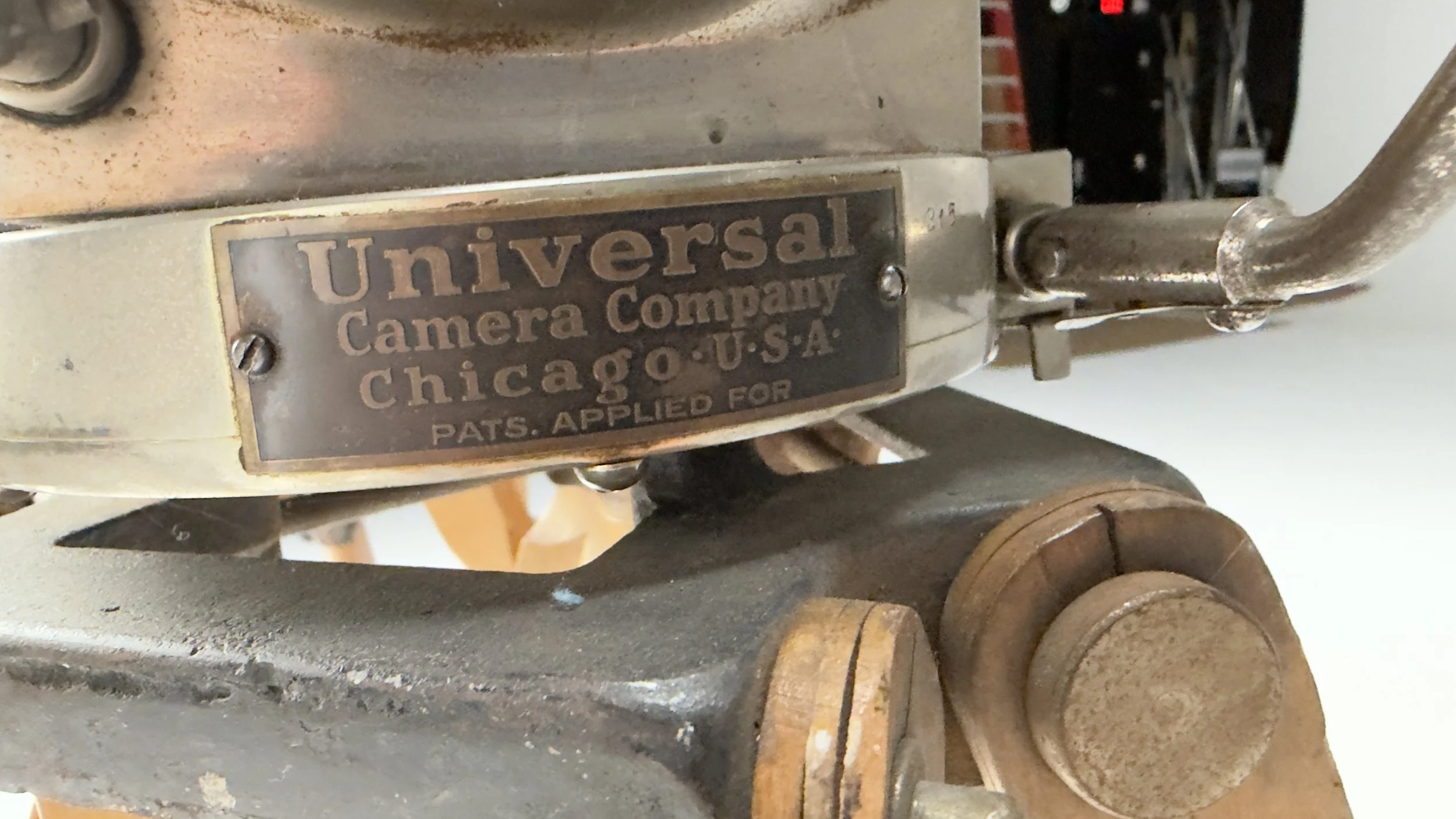
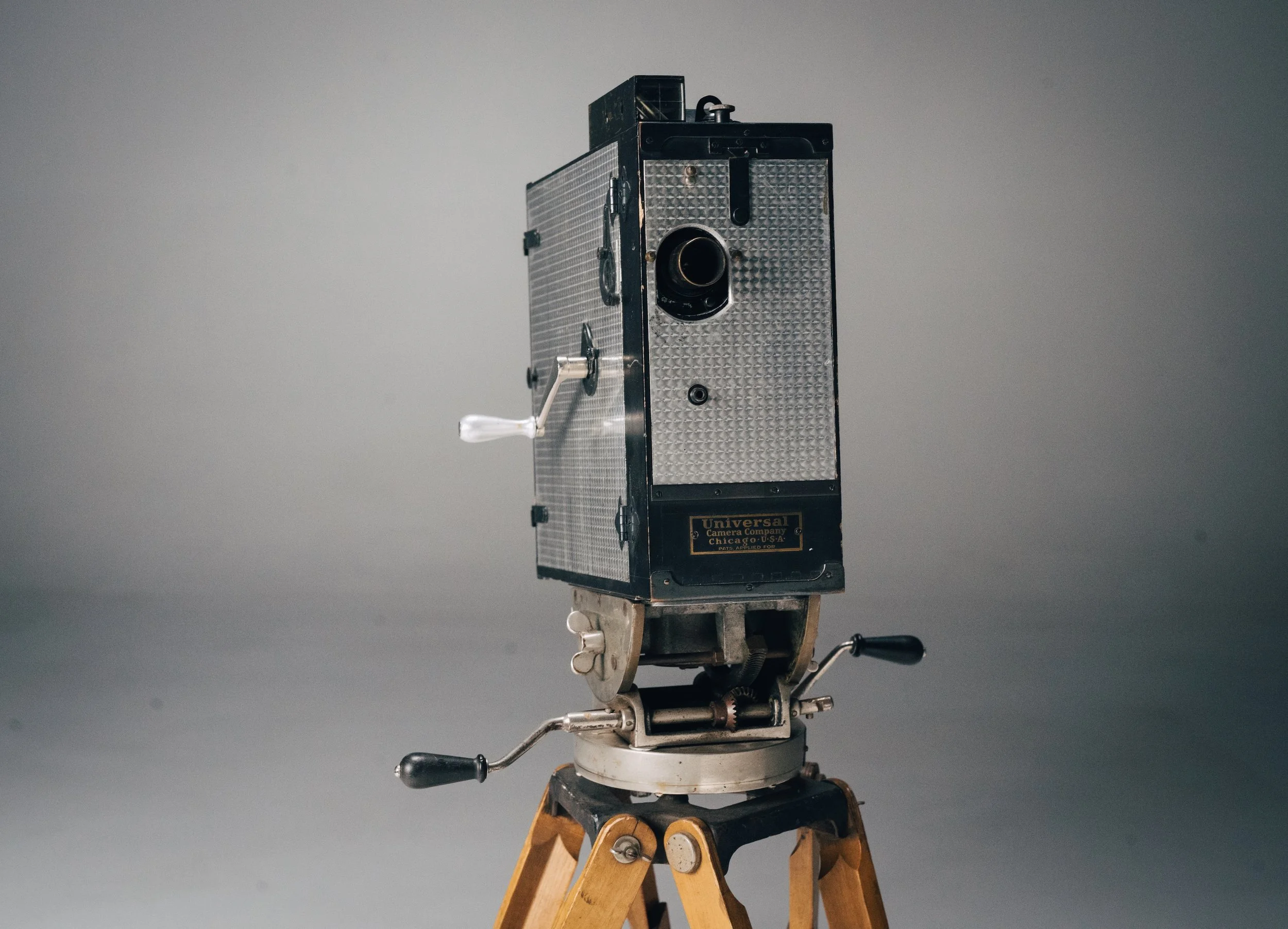
The earliest examples were labeled simply "Universal Camera Company, PATS. APPLIED FOR." Once mass production began, slight modifications were made to the body, and the camera was labeled "Universal Camera — MODEL A," with a Model B and Model C following in due course. The earliest examples are distinguished by a larger front lens board, among other minor differences.
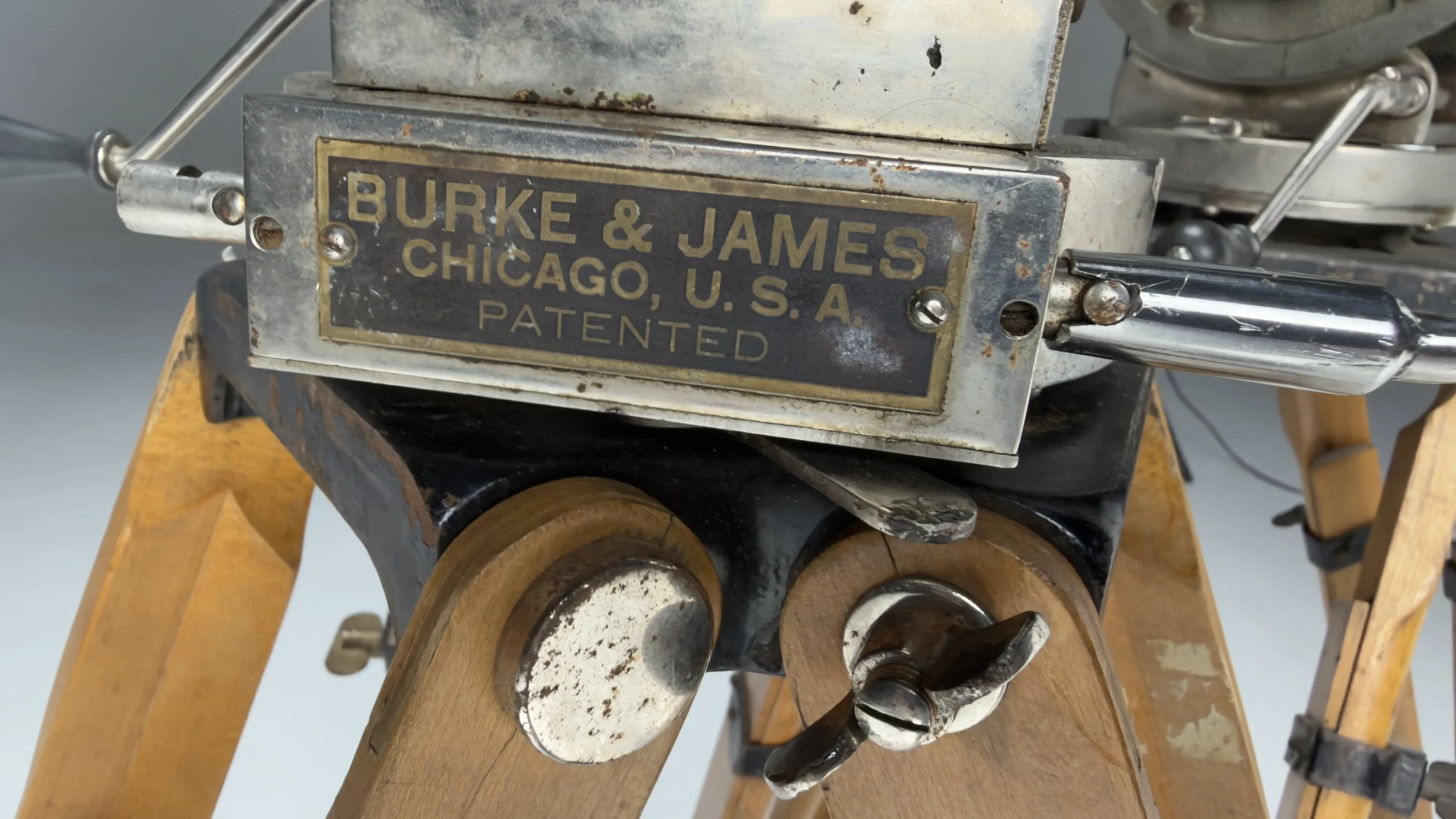
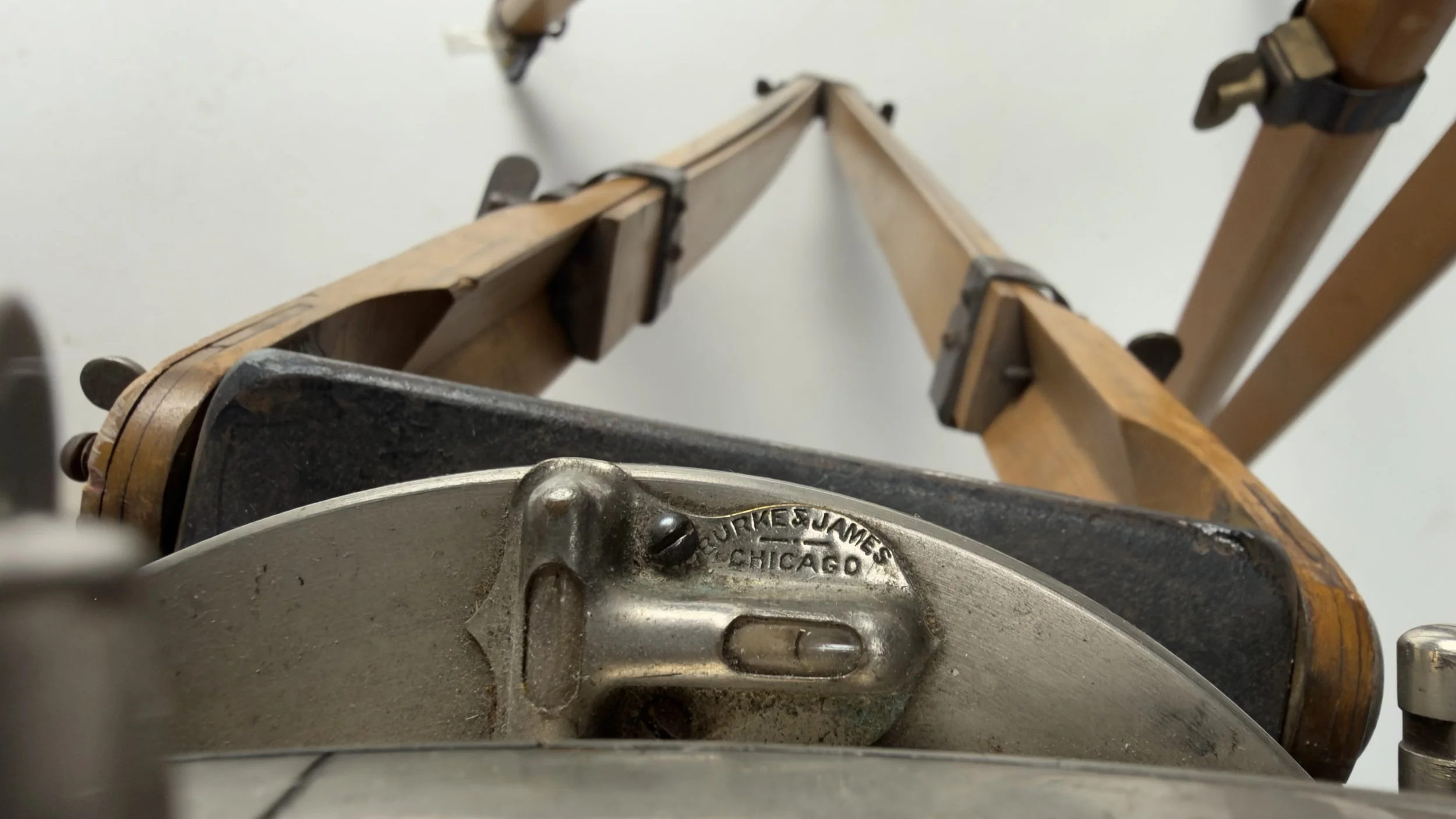
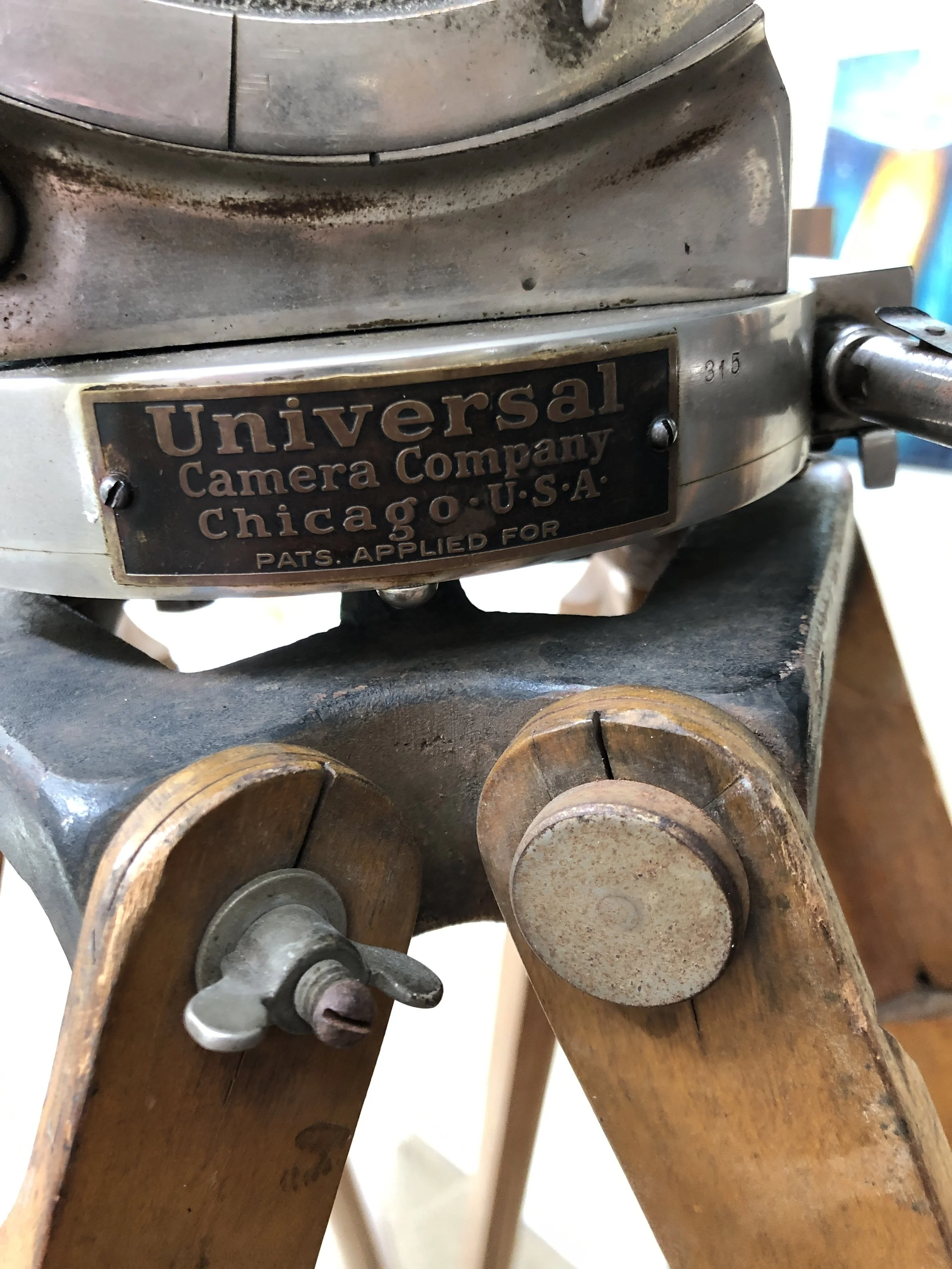
Two different styles of tripod head are also known. The earliest are labeled "Universal Camera Company, Chicago USA — PATS. APPLIED FOR" [serial no. 315], while later examples adopt the "Burke & James Chicago USA — PATENTED" label [serial no. 974]. The change in labeling neatly tracks the camera's corporate history — from the Universal Camera Company originals, patents still pending, to Burke & James production after the line changed hands.
Selling the Universal
Burke & James understood something their competitors were slower to grasp: the next market for the motion picture camera was not the studio, but everyone else. Their advertising of 1919–1921 hammered one theme — "It is as easy to make motion pictures as to make ordinary snapshots" — and aimed it at explorers, travelers, lecturers, industrial concerns, and small-town news stringers selling footage to the weekly newsreels.
The centerpiece of the campaign was a free book: Motion Photography, the very booklet this article is drawn from. Part instruction manual, part catalog, it taught the beginner focus, exposure, and composition — complete with shutter-opening tables, lens aperture charts for everything from "street scenes" to "aeroplanes in flight," and the advice to buy a Harvey Motion Picture Exposure Meter ($2.00). Then it sold them everything else: Cooke, Tessar, and Goerz lenses; the Dallmeyer F/1.9 — "the most rapid lens regularly made for any class of work in the world"; Wohlite portable lamps; Brenopticon lantern projectors; and the Stineman developing system, a portable darkroom that let an expedition develop its film on the spot, anywhere in the world.
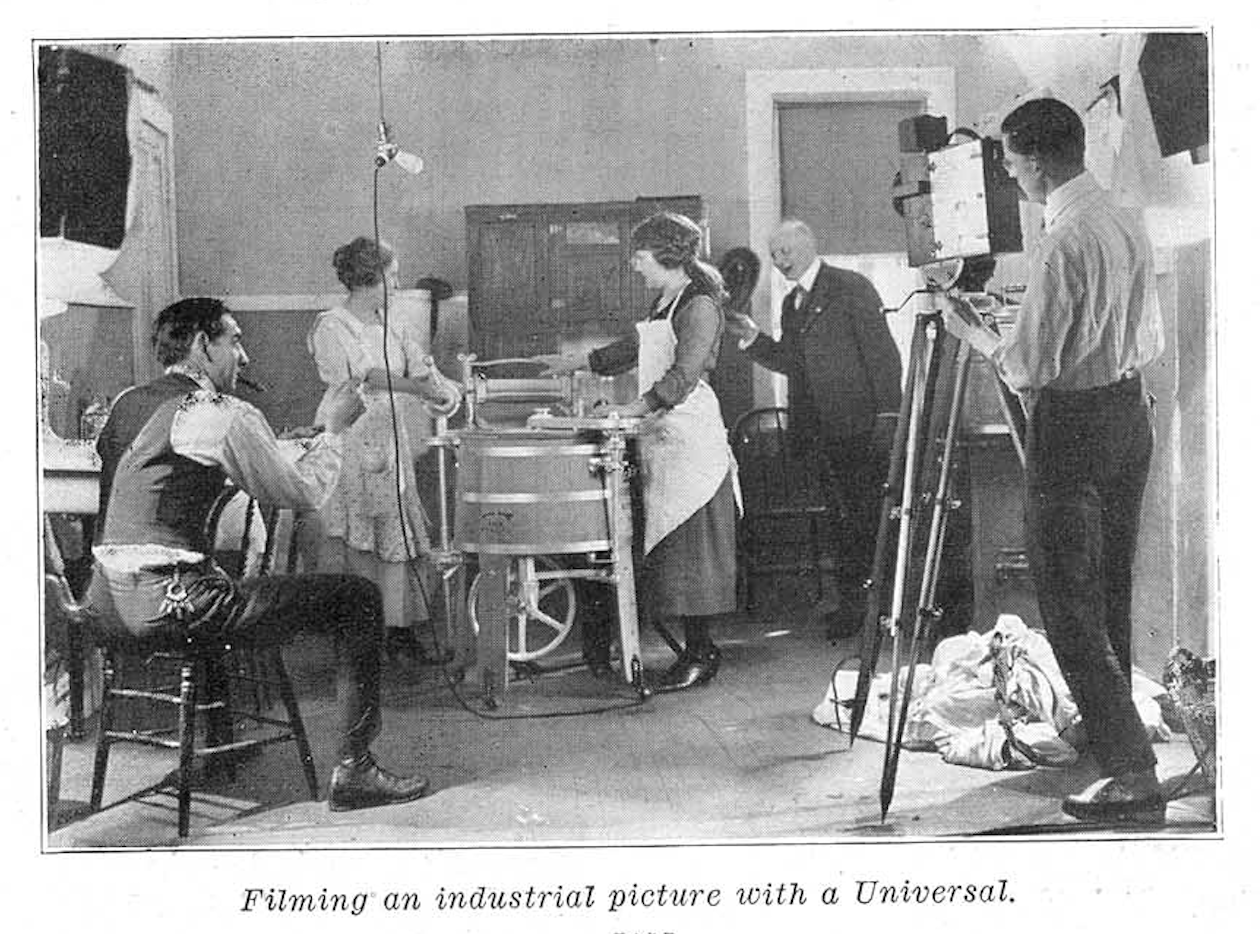
The industrial pitch was equally sharp. The catalog argued that a firm could buy a Universal and make its own advertising films, with "the saving on the first couple of films sufficient to pay for the camera." The Venard Photographic Company of Peoria, Illinois — an industrial film specialist that flew photographers to location by aeroplane — used Universals exclusively, and said so in an unsolicited testimonial letter that Burke & James gleefully reprinted in full.
The Universal found its way into the studios as well. Its reliability and low cost made it a practical field camera, and many major Hollywood studio camera departments maintained an inventory of Universals for location work, scenics or as a second camera on larger productions.
“We have, in fact, had such good success with our air-plane photography that we are now putting in our own plane for this class of work, and can assure you that there will be no other but Universal Cameras used.”
The Explorers
It was the explorers who gave the Universal its legend, and none more than Martin and Osa Johnson. The Johnsons sailed for the New Hebrides in 1917 and came back with the footage that became Cannibals of the South Seas (1918); they returned to Malekula in 1919 to film the Big Nambas again. The booklet is studded with photographs from these trips — including Osa Johnson cranking a Universal before a group of Malekulan men, over a caption noting that the camera had been "knocked about in the bottom of a whale boat for weeks at a time, carried through dense brush and is still making perfect film."
Johnson's November 1919 letter — the one quoted at the top of this article — ended with a postscript that his next feature "will create a sensation, it is the most wonderful film of exploration that has ever been made, and the photography is perfect — it was all made on the two Universals." He added: "It will probably be called Wild Men of Malekula." Burke & James ran the letter, photographs and all, as a full-page advertisement headlined "'Shooting' the wild men with a Universal."
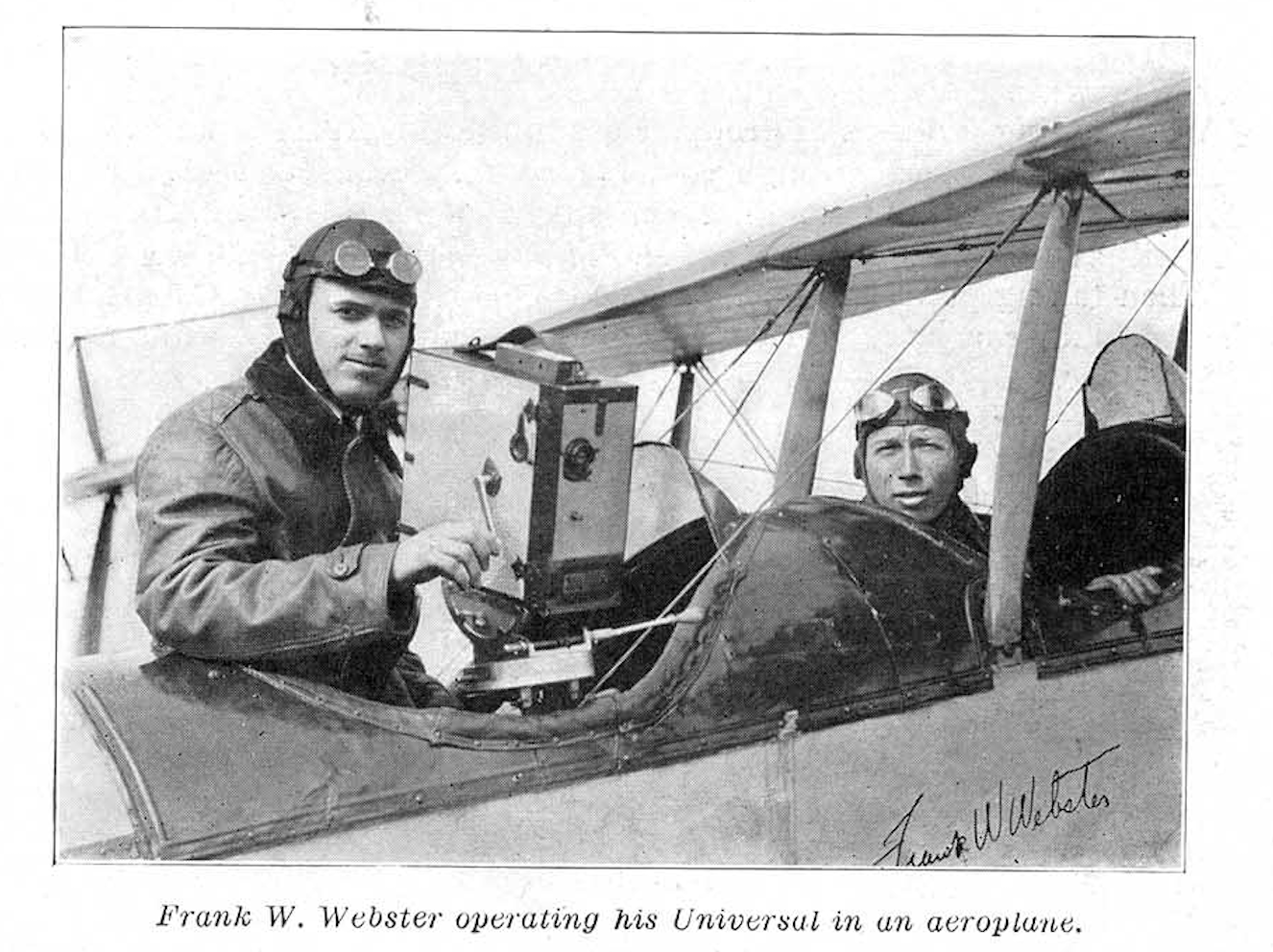
The Johnsons were not alone. The booklet pictures Burton Holmes — the Chicago lecturer credited with coining the word "travelogue" — with his Universal in the White Horse Pass, Alaska, and Frank W. Webster operating his Universal from the open cockpit of an aeroplane. The camera, the catalog boasted, "has made pictures from the Arctics to the Tropics.
The Johnsons' loyalty to the Universal lasted through the South Seas expeditions — but when their work shifted to Africa in the 1920s, they moved on to the Akeley, Carl Akeley's revolutionary round camera, designed for precisely the conditions they worked in. Akeley built cameras for the Johnsons personally — and a photograph from their 1924–1927 "Four Years in Paradise" Kenya expedition shows Martin with a previously unknown model under his arm: the Akeley Junior, which the Johnsons appear to have field-tested for their friend, and whose rediscovery is a story of its own.
What It Cost
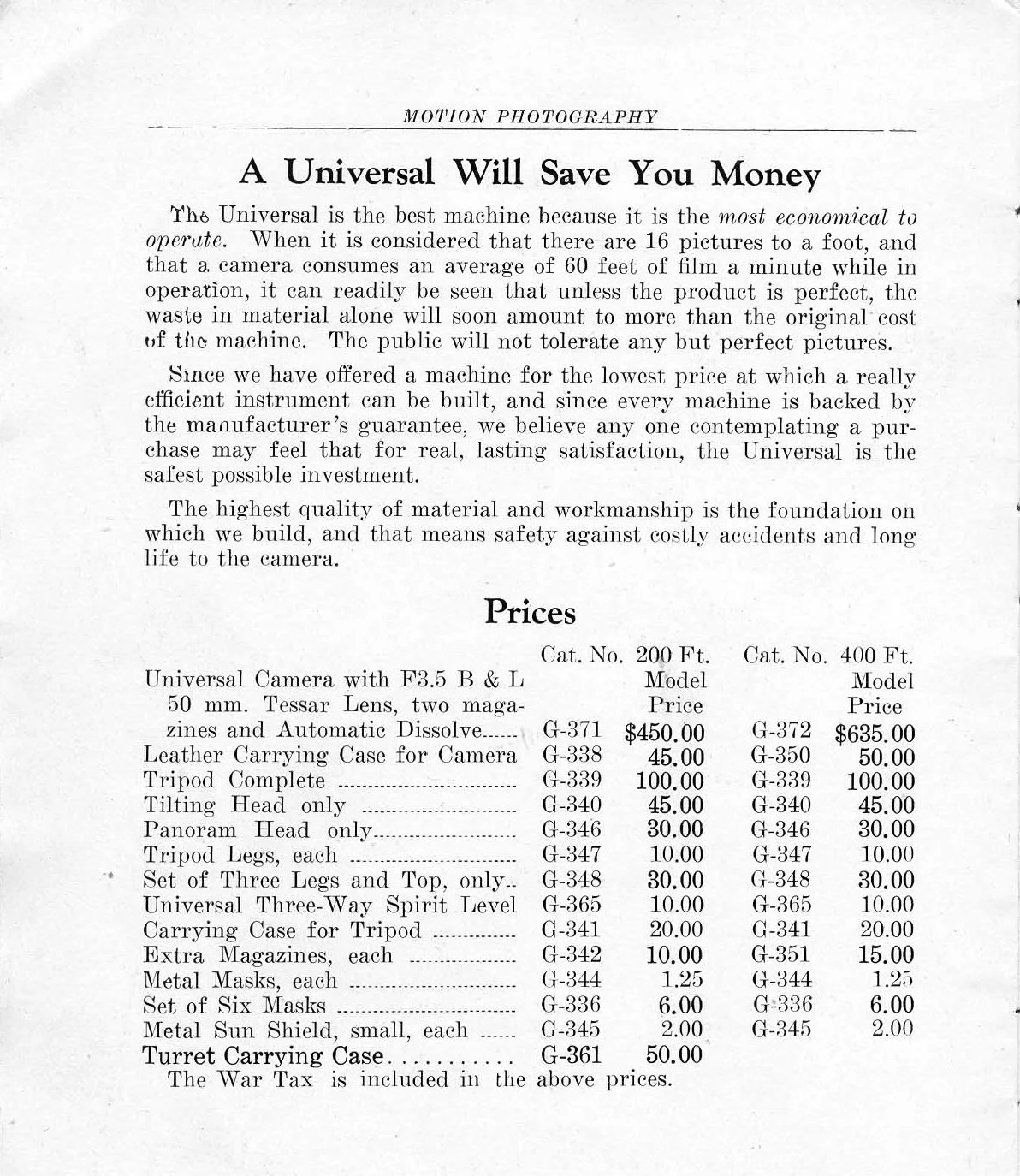
In the c. 1921 catalog, the 200-foot Universal with an f/3.5 Bausch & Lomb 50mm Tessar, two magazines, and the automatic dissolve listed at $450; the 400-foot model at $635. The complete tripod added $100, the leather camera case $45, extra magazines $10 each — a full working outfit ran roughly $600, something like $11,000 in today's money. "The War Tax is included in the above prices," the catalog notes, and the terms page warns that "owing to unsettled conditions, all quotations are subject to change without notice" — small reminders of the economy the camera was born into.
Burke & James framed the price as economy, not extravagance: at sixteen pictures to the foot and sixty feet a minute, wasted film soon cost more than the camera. "The public will not tolerate any but perfect pictures."
The Book
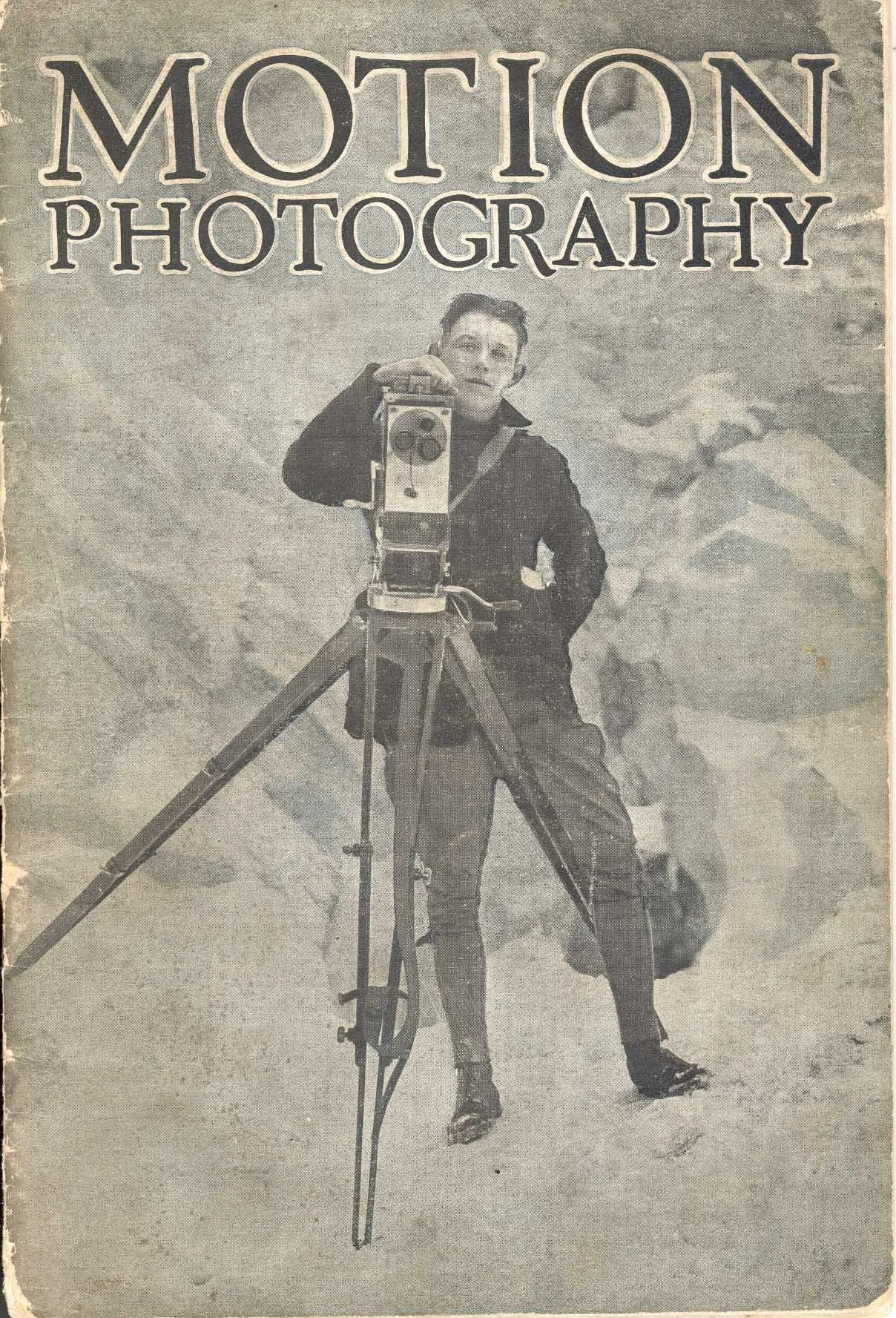
Motion Photography
The catalog drawn on throughout this article, Motion Photography with the Universal Camera, is undated, and it had a long lineage. The Photo-Miniature of January 1917 — the very month Burke & James took over the Universal agency — acknowledged receipt of "an interesting catalogue of the Universal Camera… fully illustrated," showing "the mechanism and operation of the camera in detail," and the company's advertising offered the free book continuously into the 1920s, suggesting successive revised editions. The copy reproduced here is a late one: it reprints correspondence from October 1919, speaks of the World War in the past tense, and matches two trade notices from the summer of 1921. Photo-Era Magazine of July 1921 reviewed Motion Photography with the Universal Camera — a "well-written and illustrated catalog… ready for distribution" — even noting the Goerz dissolve and trick-exposure devices listed in this very edition, and the August 1921 issue of American Photography reported that Burke & James "has just issued for distribution" a catalog of Universal cameras entitled Motion Photography. Together they place this edition in mid 1921-22. Researcher Buckey Grimm provided the American Photography reference. The complete book is available here.
Afterlife
The Universal soldiered on through the 1920s in its successive models as the hand-cranked field camera slowly gave way to spring motors and, eventually, electric drive. Burke & James themselves carried on for decades as one of America's great photographic houses, but the Universal faded with the market it had served, and survivors today are scarce: a dependable workhorse, used hard in exactly the rough conditions it was sold for, with predictable consequences for the survival rate.
That, in the end, is the Universal's story. It was never the most sophisticated camera of its era — but it was strong, simple, reasonably priced, and absolutely dependable, and it put motion picture making into the hands of people far beyond the studio gates. The film record of the early 1920s — the newsreels, the industrial films, the expedition footage from Malekula to Alaska — owes more to this plain Chicago box than its obscurity today would suggest.
Image Gallery
REFERENCES
The Camera magazine, Volume 21, January 1917, p. 110
The Photo-Miniature, Vol. XIV, No. 157, January 1917, p. 213 — notice of a Burke & James catalogue of the Universal Camera
Photo-Era Magazine, July 1921 — review of Motion Photography with the Universal Camera
Motion Photography with the Universal Camera, Burke & James Inc, Chicago [c. 1921]
American Photography, August 1921 — notice of booklet publication (dating courtesy of Buckey Grimm)
Martin Johnson, letter to Burke & James, Sydney, November 9, 1919 — reproduced in Burke & James advertising, March 1920
C. L. Venard, letter to Burke & James, Peoria, October 23, 1919 — reproduced in Burke & James advertising
The Universal Camera Company tripod advertisement, Chicago [c. 1917]
Burke & James period advertisements, 1919–1921
Made-in-Chicago Museum — Burke & James, Inc., est. 1897
Martin and Osa Johnson — biographical sources on the 1917 and 1919 New Hebrides expeditions
Auction and collection records: Bonhams (Universal Model C), private collections
Autry Museum Collections Online — camera, motion picture (set), Maker: Schustek, 1916